Wednesday, May 4, 2016

IN THE SHOP: A Patek Beta 21 With Full Set, A Meters-First 5513, A Great Nivada, And Two New Travel Cases

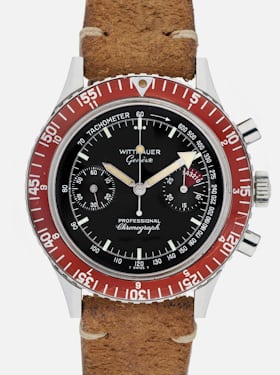
And we're back! This week, we've gone ahead and found you some absolutely remarkable things, truly. You know, we love a meters-first 5513 Sub as much as the next guy (oh, btw we've got one of those this week and it's awesome), but so much of what we believe in is appreciating the little guys, and finding value where others do not. So today we have some very rare pieces that may not impress the girls at the bar or the guys at work, but believe us, walk into a room full of watch nerds with one of these guys and you're a king.

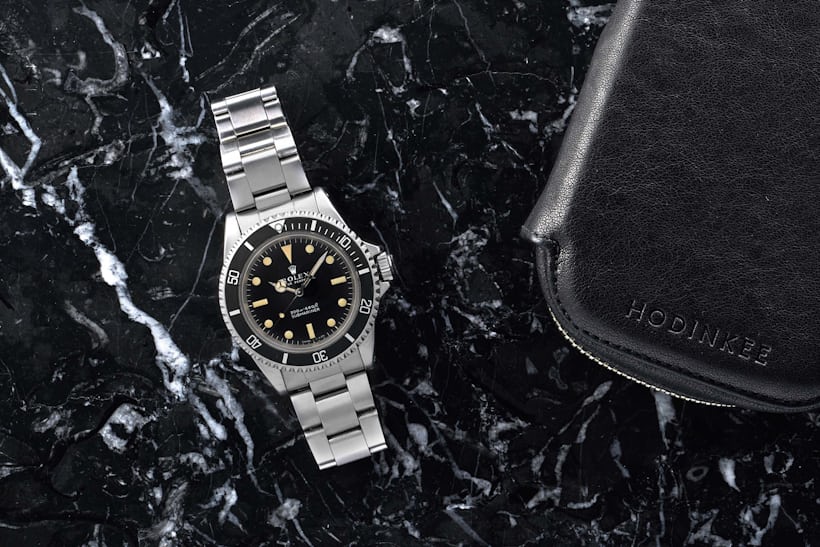
1960s Rolex Submariner 5513 (Meters First)

1960s Rolex Submariner 5513 (Meters First)

Okay, we'll do this one first. It's a killer 5513, meters first, dating to the late 1960s. It's about as nice as you're going to find, with a thick, even case, and beautiful vanilla patina to the dial and hands. Get it while you can right here.

1950s Philip Octagon With Two-Tone, Mirrored Dial

1950s Philip Octagon With Two-Tone, Mirrored Dial

Now this is a really, really beautiful, unusual watch. Made by the Philip Watch Company during the Swiss watchmaking industry's hey-day, it features a hardly worn octagonal case in stainless steel with a stunning cross-haired, two-tone mirrored dial. This watch is all about design and quality, and the angles on this case are razor sharp, the dial unmarked, and it even has the original sticker on the case back. You will not find another like this, and though it's a little on the small side (maybe a great watch to give to your sig other and "borrow" on the reg?), it offers a lot for the price. Find it here.

1950s Telda Split-Seconds Chronograph In Solid Gold

1950s Telda Split-Seconds Chronograph In Solid Gold

You want a real watch without spending a ton of money? This 1950s Telda is practically impossible to beat. Why? This is a split-seconds chronograph, from the 1950s, in solid gold, for less than than price of a new Daytona. While Telda isn't exactly a hot brand at the moment, that's just because we never see them. And in fact, this watch features a modern-wearing 38 mm case and the same split-seconds movement you'll find in those $50,000 split-second Breitlings – the Venus 185. This is a superb watch with so much going for it, and it won't last long. Find it here.

1970s Patek Philippe Reference 3597/2 Beta 21

1970s Patek Philippe Reference 3597/2 Beta 21

The Beta 21 ain't your average quartz movement, and this reference 3597 Patek ain't your average quartz watch. The Beta 21 is considered the holy grail of quartz movements, developed by the highest echelons of the Swiss watchmaking industry in response to Seiko's quartz movements; the Beta 21 found homes inside the like of Rolex, Piaget, and Patek Philippe. It was enormously expensive, selling for many times the average mechanical Patek Philippe in the 1970s, and these have become absolutely iconic watches to collectors. Hell, even two of our guests on Talking Watches own similar watches. They are that good, and that special. Oh, and the one we've found has full boxes, papers, original certificate, Patek buckle, and original bracelet. Find it here.

More Watches

We've also found you some great other chronographs and one exceptional Rolex Day-Date – white gold, bark finish, in Italian. This is about as hot as it gets. Check out all available watches right here.

Oh, And Some New Awesome Travel Cases!

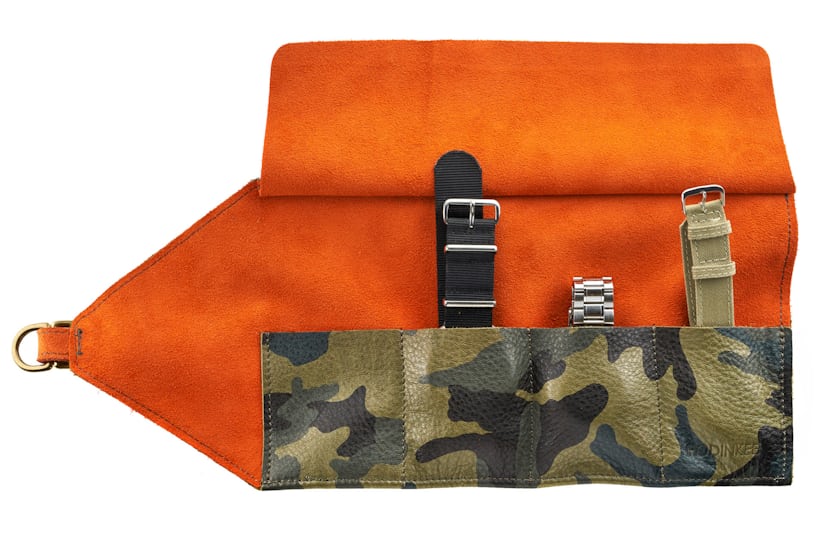
HODINKEE Travel Case

As always, we're working away on bring you guys the very best in wristwatch accessories and travel gear. Today we're thrilled to launch some new hotness. The first includes these four watch leather rolls in camo. They're super fly and available here.

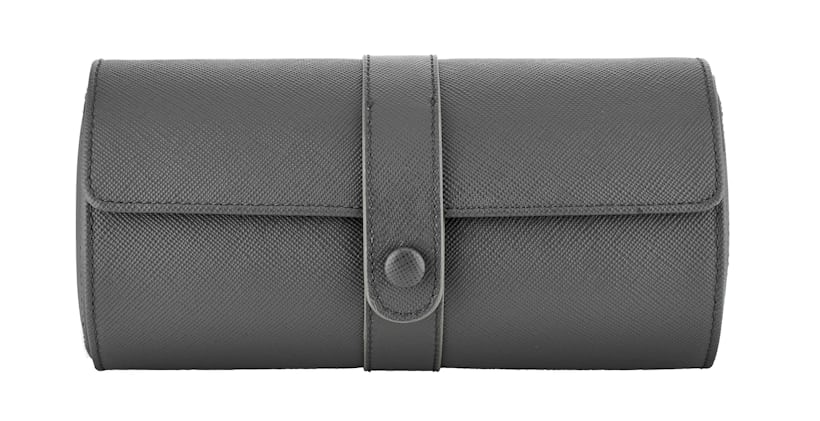
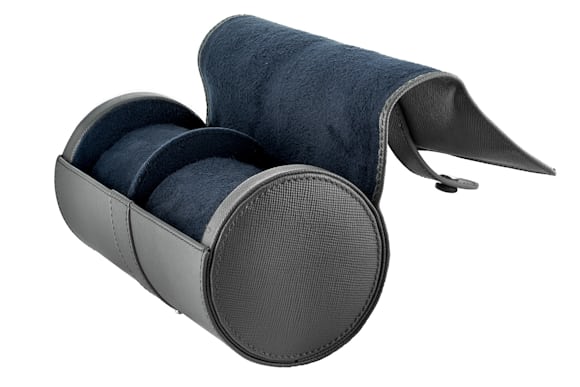
Next, we have a super, super nice two-watch case that was the result of many requests by you guys. This watch features two distinct compartments, to protect a watch from hitting another, and is perfect for any watch on a structured bracelet.

This one comes in three different options: grey textured leather, or super soft, supple calf leather in black or brown. Find it here.

Tuesday, May 3, 2016

A Week On The Wrist: The Vacheron Constantin Overseas Ultra-Thin, And Some Highly Subjective Thoughts On The Perfect Watch

We first saw the Vacheron Constantin Overseas Ultra-Thin at the SIHH last January, and at the time, our impressions based on the brief exposure afforded by a meeting in the middle of a busy trade show were limited to "seems nice, pretty expensive, too bad it's not in steel." To a certain extent those are still the impressions I have of the watch, but after a week of wearing it, they've become (I hope) more nuanced. Let's look at what it's like to live with one of the most austere (and pricey) time-only watches in the world.

Vacheron Constantin Overseas Ultra-Thin

The Vacheron Constantin Overseas Ultra-Thin is indeed a very flat watch, with a case thickness of 7.5mm (and a diameter of 40mm).  The movement is the Vacheron caliber 1120, which, as we mentioned in our earlier introductory coverage of this watch at the SIHH, started life in 1967 as the result of a collaborative movement development program which involved Jaeger-LeCoultre, Audemars Piguet, Vacheron Constantin, and Patek Philippe; AP, VC and Patek all used the movement under different caliber designations, with Jaeger-LeCoultre producing it as the JLC caliber 920, although JLC has never actually used the movement in their own watches.  The movement was at the time of its launch in 1967 the thinnest full rotor self-winding movement in the world, and rather amazingly, it remains the holder of that record today, 49 years later.  Naturally, it's mostly been used in watches notable for their slim profiles.  The thinnest watch from Vacheron using this movement isn't the Overseas Ultra-Thin, but rather, the Historiques Ultra-Thin 1968, a square-cased wristwatch with a case thickness of 5.4mm, water resistant to 3 bar/30 meters.  Audemars Piguet's Jules Audemars Extra Thin, which uses the same movement, is 6.70mm x 41mm; the Royal Oak Extra Thin, which uses the caliber 2121 – the same movement as the VC1120/AP2120, but with the addition of the date – is 8.10mm thick, at 39mm in diameter, with a water resistance of 50m.

Vacheron Constantin Overseas Ultra-Thin dial and alligator strap Vacheron Constantin Overseas Ultra-Thin movement

The very first watch from Vacheron Constantin to use the caliber 1120 – without date – was the reference 7398, in September of 1967; this was a round, flat (obviously) dress watch, and it was one of three watches launched that year by VC (references 7399, with a cushion case, and reference 7400, another round watch, followed later in the same year).
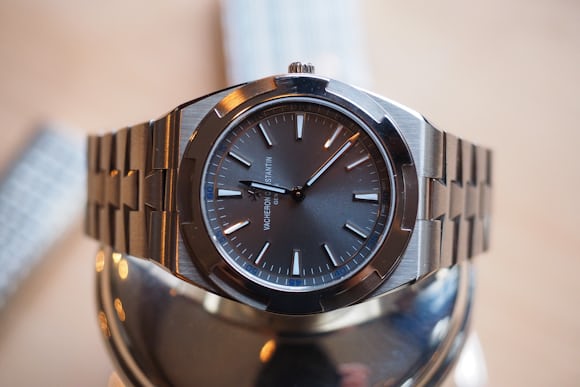
Vacheron Constantin Overseas Ultra-Thin side dial Vacheron Constantin Overseas Ultra-Thin bracelet lifestyle

Right at the outset, the Overseas Ultra-Thin is an extremely seductive watch.  Unlike many ultra-thin watches, which more often than not come on straps and are extremely light in the hand, as well as virtually unnoticeable on the wrist, the Overseas Ultra-Thin has a palpable heft to it.  Given the slender profile, it's not an unpleasant sensation at all; there is just enough weight to the watch, on its bracelet, that you're aware of its presence, and when you combine that with the suppleness and beauty of execution of the bracelet, putting the Overseas Ultra-Thin on for the first time is very much a "wow" experience.  

Vacheron Constantin Overseas Ultra-Thin bracelet flank Vacheron Constantin Overseas Ultra-Thin bracelet detached

Whether by luck, or design, or some serendipitous combination of the two, Vacheron's managed to create a kinesthetic experience in the watch as a whole that has to be felt to be believed.

The bracelet on the Overseas Ultra-Thin is absolutely phenomenal.  The combination of brushed and polished surfaces catch the light in a really mesmerizing way, and the wonderful level of finish on the white gold links and clasp, combined with the mass of the watch, give it a feeling in the hand and on the wrist I really can't recall getting from any other watch bracelet I've ever handled.  It's not just the just-right mass or the beautiful metalwork, it's the combination of the two, and the bracelet is so comfortable that it feels almost alive.  As much as this might put off those with phobias about snakes, the sensation is very akin to handling one – there's a sense of flexibility and suppleness, sure, but also connectedness, so to speak. It's one thing for a watch to have nothing to which you can object; it's another thing to have it draw you in in what feels like an almost active fashion, and it's almost unnerving – as if it really does have that life-0f-its-own quality that so many of us want in a watch but seldom really get.  Whether by luck, or design, or some serendipitous combination of the two, Vacheron's managed to create a kinesthetic experience in the watch as a whole that has to be felt to be believed.

Vacheron Constantin Overseas Ultra-Thin bracelet light

Wearing a watch like this can be, depending on your tastes, very much an exercise in what you might call horological sufficiency.  I always wonder, when I'm test-driving a watch, whether or not it could be a watch you'd wear as your daily wear watch.  Sometimes the question is dead before it can leave the gate – most specialist complications aren't candidates, for obvious reasons; many sports watches are not, due to size or other design aspects that limit their versatility; many dress watches are obviously too fine to be anything other than, well, dress watches.

The Overseas Ultra-Thin, on the other hand, comes very, very close to being an unequivocal yes in terms of not only being a watch you could wear every day, but also a watch you would want to wear every day.  It's fine enough to be suitable for pretty much any occasion I can imagine short of by-the-book white tie (and you might be able to get away with it even then).  It's also, interestingly enough, quite robust for an ultra-thin watch, as befits its membership in the Overseas family.  It's antimagnetic, to a degree – there's no full soft-iron enclosure but there is a soft iron casing ring, which provides, if not a similar degree of protection as a full inner case and dial, at least some degree of protection (in the same way a full enclosure would: by providing a preferred pathway for magnetic field lines).  It's even rated to 5 bar/50 meters water resistance.

Generally speaking, when I'm wearing a watch for A Week On The Wrist I want to have at least a little time away from it; and as a rule, it's nice to take at least a little break from wearing a review piece.  (Sometimes it's a big relief; try wearing a watch you don't really care for personally for a whole week.  It's like having a houseguest you can't get rid of.)  I can honestly say that in the case of the Overseas Ultra-Thin, taking it off was always an occasion for regret and putting it on again after having been away from it, even for a short time, was always a source of that small but distinct pleasure we all always hope to get from any watch.  It was a reminder that watches are very intimate things and unlike a lot of jewelry, are often worn on a daily basis – as such, they need to be something you can love on a daily basis, not just tolerate.
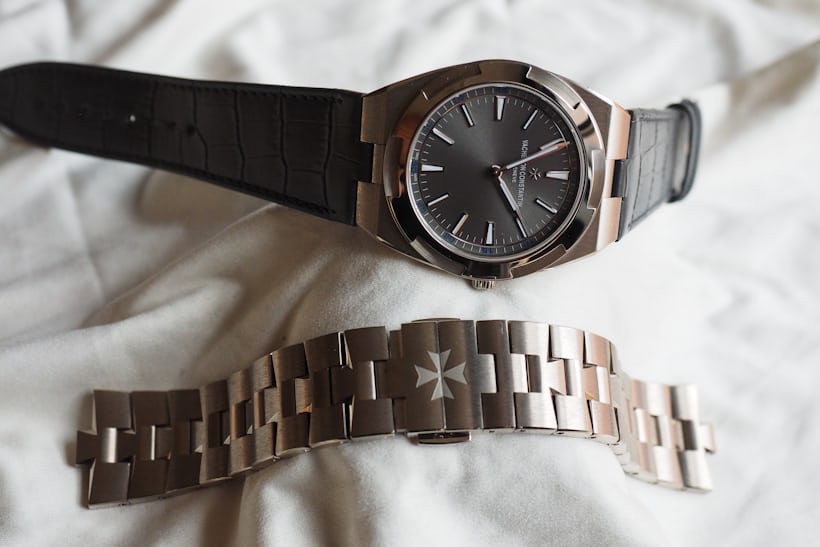
Vacheron Constantin Overseas Ultra-Thin strap and bracelet comparison

Now of course, one of the most interesting features of the Overseas Ultra-Thin is that you don't get just a bracelet.  The Overseas Ultra-Thin uses the new interchangeable strap system that Vacheron has rolled out for its revamped Overseas collection.  Such things can seem gimmicky of course, or at least, a little déclassé (we've all seen swap-able straps used to try to sell undistinguished watches) to say nothing of unnerving if you don't feel absolutely sure that the locking system is secure.  In this case I'm happy to say the system works extremely well.  It's very quick, it's dead simple to use, and happily enough, the watch takes on a very different character depending on what you've chosen to keep it on your wrist.  Changing the strap or bracelet is also an opportune time to see just how thin the watch really is – not record breaking, but still, pretty damned flat.

Vacheron Constantin Overseas Ultra-Thin bracelet detached Vacheron Constantin Overseas Ultra-Thin next to a quarter Vacheron Constantin Overseas Ultra-Thin side view on strap

With the white gold bracelet, this is a quiet but definite exercise in luxury, especially if you can easily distinguish the grey pearlescence of white gold from the colder, more forbidding frostiness of polished steel. Put the watch on one of the straps you get with it, though – you have a choice of either rubber or black lined grey aligator – and it becomes something you could wear either to a day at the beach or to a formal event, depending on your mood and circumstances. To change the strap or bracelet, you just push in the little tabs hidden in the end-links of the bracelet or the ends of the strap (where spring bars would normally sit) and you can slide the strap or bracelet off; to attach one, you just snap it into place. In the week I had the watch for review, there were absolutely no issues with security with the system.
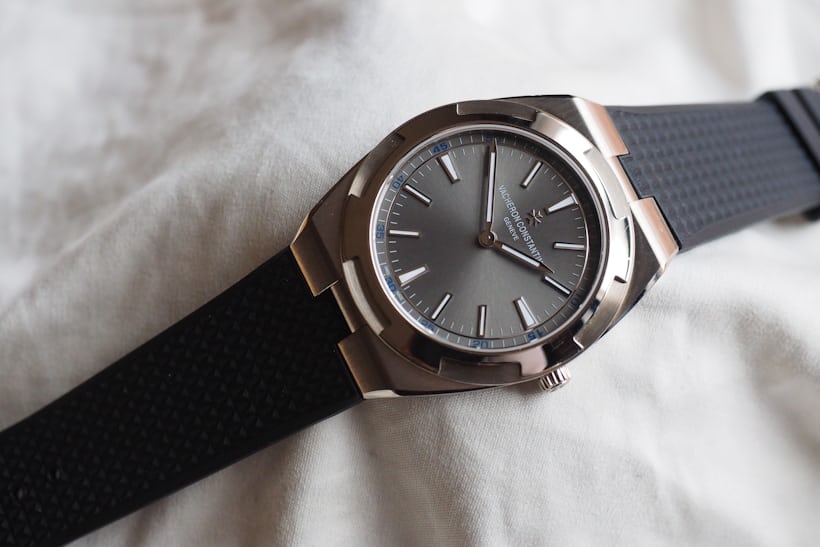
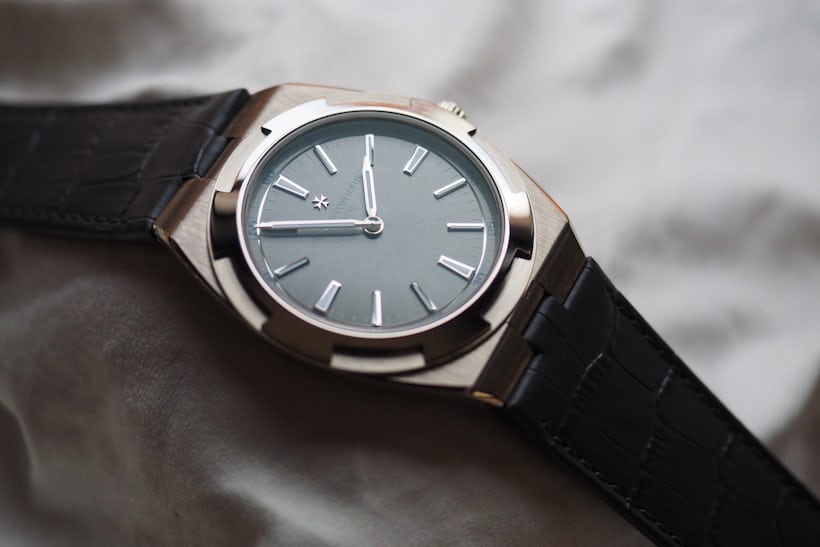
Vacheron Constantin Overseas Ultra-Thin on rubber Vacheron Constantin Overseas Ultra-Thin on alligator

There are all sorts of notions about what makes a watch design successful.  Some are contextual of course – a minimally legible diver's watch, or a watch with poorly designed ergonomics that make it hard to operate, are by any reasonable definition of design, designed badly.  From both an aesthetics and functionality standpoint, there is always a tendency to fall back on rules of thumb that may or may not yield good results – "less is more" is probably one of the worst culprits, because less is definitely not more except under very specific circumstances.  What people really mean – or really should mean, anyway – when they say "less is more" is "every element is flawless in itself, stands in the best possible relationship to every other element, and there's nothing unnecessary to detract from either aesthetics or functionality."  That is a very, very hard set of criteria to fulfill, but as reluctant as I am to say it for various reasons – the price of the Overseas Ultra-Thin, for one, and a general resistance to seeming too subjectively involved in a review for another – I'm forced by the overwhelmingly positive reaction I had to the Overseas Ultra-Thin to say that it comes awfully, awfully close.

Vacheron Constantin Overseas Ultra-Thin wrist alligator Vacheron Constantin Overseas Ultra-Thin wrist bracelet Vacheron Constantin Overseas Ultra-Thin with strap options

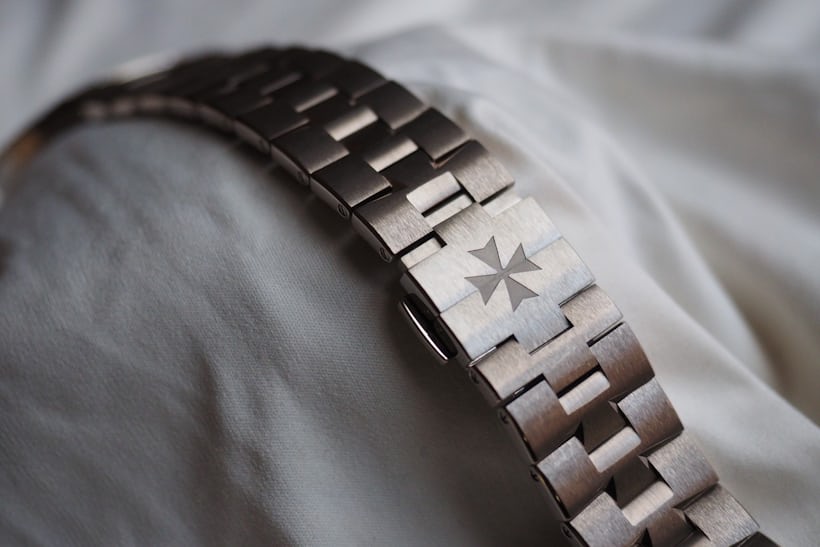
So is this a perfect watch?  Of course it's not; the question has no real meaning, except to function as what philosophers like to call an intuition pump.  But it is, if you're susceptible to its particular suite of charms, an almost irresistible watch; and even if you're not, I think it's hard to avoid seeing the degree of design intelligence it represents.  There are all sorts of ways this thing could have gone off the rails – the twee and unnecessary resurrection, for instance, of the Maltese cross medallion on the lower right hand corner of the case, from the vintage 222; it would have been cute, sure, but it would have been a mistake – one of those tiny but fatal holes out of which all the rightness of a design can leak. (So would have been a seconds hand, or a date window.) Should this watch have been offered in steel?  It would have been a less expensive watch but it also would have been a completely different one; everything from the appearance of the metal to the effect of the finishing methods, to the overall sense of appealing but not overwhelming mass that this watch has in white gold, would be absent in steel.  (This is not to say that the Overseas Ultra-Thin would be a bad watch in steel – very likely it wouldn't be – but it's worth pointing out that it would be a very different watch).  Is it too expensive?  The question is prima facie absurd – of course it's too expensive, too expensive by half, and by any rational measure, you should take one look at the price tag, think of all the other watches you could get for nearly sixty thousand dollars, and say to yourself, "Well, this is Nature's way of saying, 'don't touch.'" (To be fair, however, the AP Jumbo in rose gold, the closest thing I can think of to the VC Overseas Ultra-Thin, with exactly the same movement but for the date guichet, is almost exactly the same price.)

The only problem with that, is that any other watch wouldn't be this watch, and if you want this watch – with its all-too-rare ability to seem both wonderfully simple without being simplistic; with all its design purity; with all its capacity to remind you just how satisfyingly right a few components standing in perfect harmony to each other can be – it's going to cost you, more or less, $55,700 dollars.

It's a little maddening that less costs so much more, but at least in this case you can take more than solace in the fact that less really is more.


The Vacheron Constantin Overseas Ultra-Thin Reference 2000V/120G-B122: case, 40mm x 7.50mm, white gold. Antimagnetic casing ring, water resistance 50 meters.  Dial, grey-lacquered, sunburst satin-finished base with velvet-finished minute-track.  18k white gold hands and markers.  White gold bracelet, grey alligator or rubber strap.  Movement, caliber 1120, 40 hour power reserve, 2.45mm x 28.4mm, 19,800 vph, running in 36 jewels.  Geneva Hallmark. Available August-September 2016; price, $55,700.  Visit VC online here.

Don't have the HODINKEE App yet? Get years of amazing watch content plus new stories, breaking news, and access to great new features like HODINKEE Live, free on iOS.

Hands-On: A Closer Look At The New Zenith Elite Chronograph Classic Blue Dial (And Why The Change Is More Than Skin Deep)

Zenith caught us by surprise back in 2015 when they introduced a very handsome dress chronograph called the El Primero Chronograph Classic. We're used to mostly sporty stuff from the Le Locle manufacture nowadays, but we nonetheless enjoyed the simplicity of the watch, which reminded us that chronographs can be elegant complications when they want to be.

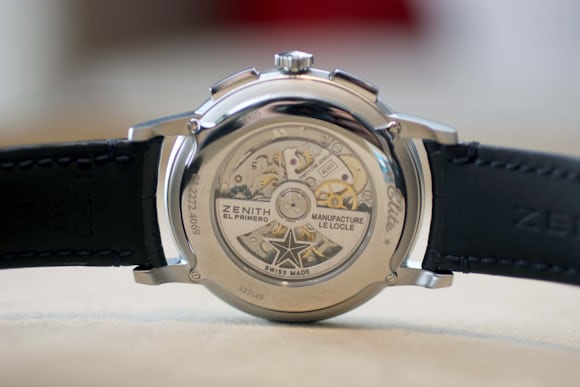
The model did very well, beating Zenith’s own expectations, or so we are told, and encouraging them to introduce an interesting follow up only 12 months later. The new iteration – renamed the Elite Chronograph Classic, and moved to the Elite collection – is everything its older brother was, with the exception of the dial, which has gone from a steely silver to a beautiful deep blue. It went mostly under the radar at Baselworld 2016, but deserves a closer look.

Zenith Elite Chronograph Classic Blue Dial

The color change may not seem like much, but there are a couple of things to say about the new domed dial – which is made at ArteCad, a specialist owned by LVMH, as well as a handful of other dial manufacturers also based in Switzerland.

Zenith Elite Chronograph Classic Blue Dial Side

First, blue is a color Zenith usually saves for limited editions dedicated to Charles Vermot, a man who, at the height of the Quartz Crisis, disobeyed orders to destroy the manufacture’s mechanical know-how by saving equipment and designs. Such pieces have tremendous nostalgic and emotional value to Zenith.  This isn't a Charles Vermot limited edition, of course, but you can't help but feel something of his spirit here.

Zenith Elite Chronograph Classic 2015

Second, and this might explain why Zenith is ready to break with this tradition, is that blue dials are now more desirable than black dials – at least when we’re talking about modern pieces.

Zenith Elite Chronograph Classic Blue Close Up

Since the new model is otherwise unchanged, I won’t repeat what Ben has already said about the piece, after spending a week with it on the wrist. But I highly encourage you to read his review, and decide for yourself which you prefer – silver, or blue?

More than a color chance, I would have preferred to see it back in a smaller size, somewhere in the region of 40 mm, although it remains a very wearable watch – the piece is only 11.8 mm thick – and I’m sure many will enjoy its presence on the wrist.

Zenith Elite Chronograph Classic Movement

The new Elite Chronograph Classic comes on a blue alligator strap, and is listed for $6,900 – which represents a price drop of $1,500 from last year's model. As we've mentioned, the blue dial gives the watch a much altered character – with the original dial, it's a very traditional looking, somewhat austere design; with the blue dial it becomes much more eye-catching and, dare I say it, more overtly fun and outgoing wristwatch, without losing any of the underlying classicism that makes the original so attractive.

Read more about the Zenith El Primero Chronograph Classic here.

Don't have the HODINKEE App yet? Get years of amazing watch content plus new stories, breaking news, and access to great new features like HODINKEE Live, free on iOS.

Monday, May 2, 2016

Introducing: The Panerai Radiomir 1940 Minute Repeater Carillon Tourbillon GMT

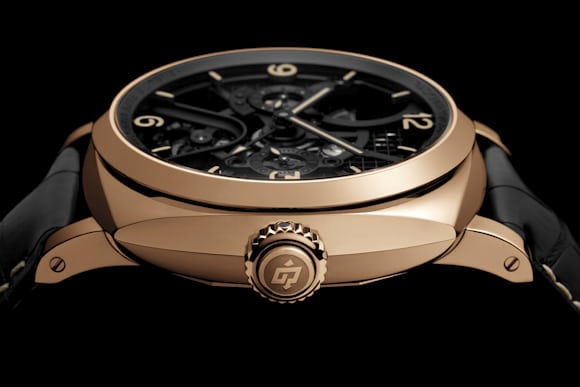
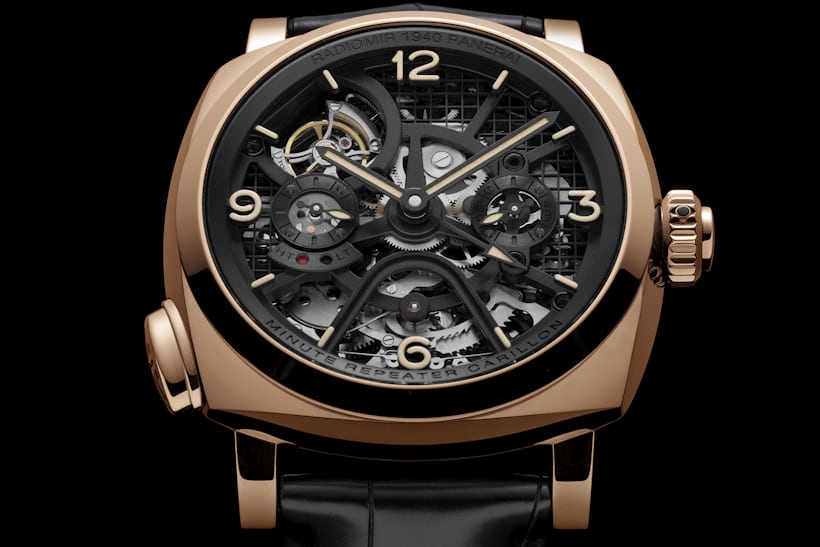
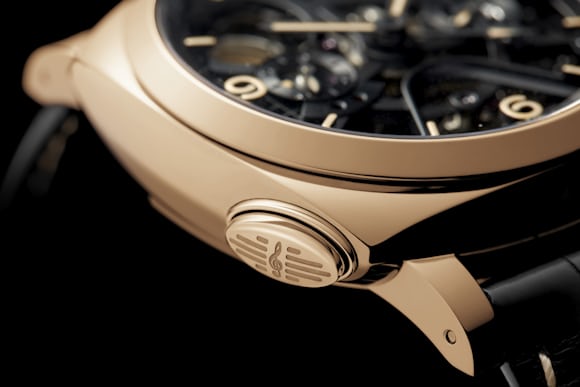
Panerai may have its roots in two watches made purely and exclusively for military operations – the Radiomir and Luminor watches – but it has been slowly and steadily expanding both its repertoire of complications, and its design vocabulary, for many years, and in doing so, it's created a far broader identity for itself as well. Radiomir and Luminor may have been intended originally to be pure instrument watches but, as can sometimes happen, purity of intent in the utilitarian produced something of great design integrity aesthetically. For some time now, Panerai has been at least as much of a design oriented as a tool watch oriented manufacturer. This extension of its scope now includes chiming complications, with the introduction of the Radiomir 1940 Minute Repeater Carillon Tourbillon GMT– a dual time, tourbillon, decimal repeater with several features we don't think we've ever seen anywhere else.

First let's talk about the tourbillon. Panerai's first in-house tourbillon movement was the caliber P.2005, introduced in 2007 (along with several other in-house Panerai calibers) and, to this day, I still think it's somewhat under-appreciated. The Panerai tourbillon has some unusual features. First, most tourbillons (in fact, virtually all) rotate in the same plane as the movement plate, while the P.2005 rotates in a plane at right angles to the plate. Second, the tourbillon is placed in the movement at such an angle as to minimize the amount of time the balance spends in any of the positions where variation in rate would be most extreme; the fact that the tourbillon's natural home is in a pocket watch, not a wristwatch, is often raised as an objection to using it in a wristwatch at all but the orientation of the P.2005's carriage does a lot to answer this objection. Finally, its period of rotation is quite fast – it's a 30-second tourbillon, which, again, helps reduce to a minimum the amount of time the balance spends in any of the most extreme positions.  

Typically the way you make a tourbillon more suitable for a wristwatch is to make it a multi-axis tourbillon – done right, this can work well chronometrically, as the performance of Jaeger-LeCoultre's multi-axis tourbillons in the Concours de Chronométrie has demonstrated – but this approach is much more complex and technically difficult (as well as awfully expensive) and as Stephen Forsey of Greubel Forsey once said to me years ago (and it's a comment that's stuck with me), it's always a struggle to gain more than you lose. The P.2005 has a lot of the advantages of a multi-axis tourbillon but is a more robust, simpler construction, much more suitable to a technically oriented company like Panerai, and I've often thought they deserve more credit for producing a tourbillon that's so appropriate to the company's identity.

Radiomir 1940 Minute Repeater Carillon Tourbillon GMT case flank

By far the most unusual aspect of the watch, however, is the chiming system. The Radiomir 1940 Minute Repeater Carillon Tourbillon GMT is one of the class of repeaters known as decimal repeaters. The term refers to any repeater that chimes the hours, then the number of 10-minute intervals past the hour, then the number of minutes past the last 10-minute interval. A conventional repeater, you'll recall, chimes the hours, then the number of quarters past the hour, then the number of minutes past the last quarter hour (up to 14 minutes). All decimal repeaters I know of, basically duplicate the chiming system of a conventional repeater – chiming is on two gongs; and the hours sound on the lower pitched gong, quarters are indicted by a double strike on the higher and lower, and minutes are struck on the higher pitched gong. Decimal repeaters strike the number of 10-minute intervals past the hour on two gongs. The Radiomir 1940 Minute Repeater Carillon Tourbillon GMT is different; it has three gongs, and three hammers. Ten minute intervals are indicated by a triple strike on the intermediate gong.

Radiomir 1940 Minute Repeater Carillon Tourbillon GMT

However, the most interesting feature of the Radiomir 1940 Minute Repeater Carillon Tourbillon GMT is related to the dual time zone function. The watch shows the time in two time zones, but rather amazingly, it can also chime the time in two different time zones – either home time or local time. Such a feat seems incredible, and in fact I don't think anyone has ever created such a chiming system before. Exactly how Panerai's done it we don't know yet in any detail, but I'm very much looking forward to finding out. Minute repeaters work basically by sensing the position of the hands; the gears that drive the hands also drive a rotating system of cams, whose position is sensed by levers that fall onto the cams when the chiming system is activity.

The achievement of on-demand chiming of either home or local time seems daunting but perhaps one clue is that after a little thought, you realize that the only difference in the chiming would be the hour strike. This doesn't make things easy, exactly – as far as I can work it out, you would still need two separate hour snails and two separate hour racks – but it's certainly easier than having two entirely separate striking systems (and I wonder, too, if the three-gong system is actually part of the solution).

Radiomir 1940 Minute Repeater Carillon Tourbillon GMT repeater push piece

This is going to be a very expensive watch, of course. It is not being made as a regular production piece, but neither is it a limited edition per se; Panerai intends to make a wide range of possible customization options available (up to and including an option to select a case metal other than red gold, though red gold is often considered the best alloy for repeaters). The base price, so to speak, is going to be around $395,000, but actual final price will vary, possibly considerably, based on which options the client chooses.

That said, this is an extremely unusual and technically unique watch in many respects – and we really can say unique, unless there is another triple-gong-carillon, dual-time-zone, dual-chime, openworked, offset-angle tourbillon watch out there, which I seriously doubt. In watchmaking you never know for sure of course, but I feel on pretty safe ground with this one. The watch will be available by special order at Panerai boutiques.

For more on Panerai, click here.

The Radiomir 1940 Minute Repeater Carillon Tourbillon GMT: case, 49 mm, 18k red gold, water resistance 3 bar. Movement, Panerai caliber P.2005/MR; time, GMT, power reserve on the back, decimal repeater on three gongs with three hammers, selectable repetition of the time for either home or local time. 16 1/4 lignes in diameter, 10.35 mm thick, 28,800 vph running in 59 jewels. Four day power reserve, twin barrels.

In-Depth: Cyborg Samurai: The Casio G-Shock MR-G Limited Edition 'Hammer Tone'

"I love Patek Philippe perpetual calendars only marginally more than I dig the Casio Frogman G-Shock – but for different reasons – and if you’re wearing either, chances are I’ll sidle over to you and start a conversation about it."

– John Mayer, HODINKEE, 2012

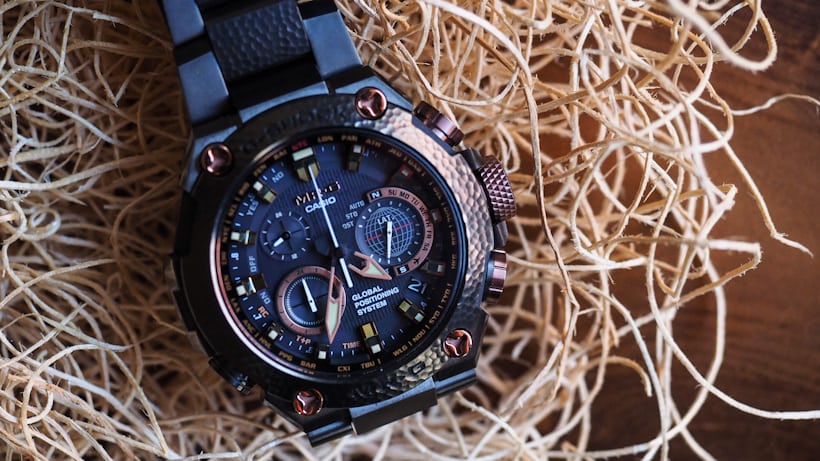
The G-Shock is a lot of things – the world's toughest watch; arguably its most practical; in some versions, arguably its ugliest. It is also, however – as John Mayer's remark above, from 2012, so pithily underscores – a watch that has achieved what as far as I can tell is a unique degree of crossover status. It's the one quartz multifunction watch likeliest to be appreciated for its qualities by otherwise diehard mechanical watch fans, and it's full of technical qualities that you have to admire from an engineering standpoint, even if you wouldn't be caught dead with one on your wrist. It would be difficult to say for sure without the sort of meticulous statistical analysis that only organizations like the NSA, or major pharmaceutical companies, can afford, but it's probably the single most-often-chosen watch for people who need a watch, and need it to be able to tolerate considerable abuse, as well – soldiers, rescue workers, police officers, and the like.

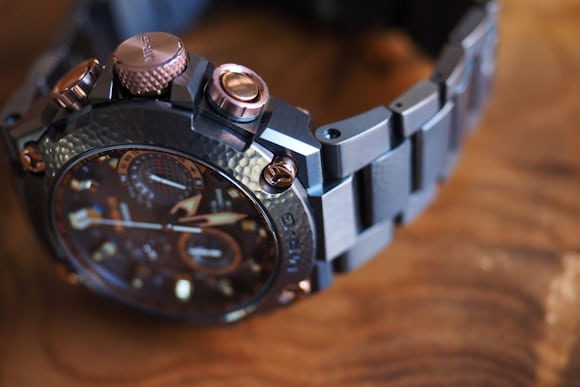
casio g shock hammer tone

It has also, however, become the focus of a worldwide community of G-Shock collectors, as well as a pop-culture staple, having appeared in films, music videos, and live performances too numerous to mention. The only other watches that I can think of offhand that combine the G-Shock's reputation for toughness and mechanical reliability with pop culture and Hollywood superstar status, are probably watches from Rolex, and as different from each other as they might seem (and are, of course, in virtually every physical respect) I've often thought that they're both as popular as they are in the U.S., at least, for similar reasons. What both watches have in common, in addition to their reputation for toughness and reliability, is their ability to project their respective identities in an instantly identifiable fashion, and for a watch, or for that matter, any luxury object, to succeed in becoming an element of mass culture, it has to be instantly recognizable, more or less. (Just ask Jean-Claude Biver, who understands very well that when it comes to luxury, winning a popularity contest often means winning a visibility contest first.)

casio g shock hammer tone bezel

In certain respects, therefore, the G-Shock is sort of ripe for appropriation as a higher end luxury object. Of course, as is often the case with appropriation of street to luxury, the pop music world was there first – quite a lot of one-off customized G-Shocks have been seen on quite a few famous wrists over the years, including Pharrell Williams' gold-cased BAPE DW-6900; for the 25th anniversary party for G-Shock in New York the likes of Kanye West and Spike Lee showed up. All this led up to the inevitable: the creation, last year, of a one-off solid gold DW5600.

As fascinating as the unlikely, and decade-long (or more) success of the G-Shock as a piece of jewelry is, the fact remains that the ornamentation was very much in a European or American style. Even the G -Shock in solid gold, which wasn't an aftermarket modification, but something actually designed and sanctioned by G-Shock creator Kikuo Ibe himself, seems very much a product of an Americanized design sensibility. In any case, and for whatever reason, Casio decided to make a luxury-leaning version of its most relentlessly practical watch that was as Japanese in its ornamentation as the G-Shock itself is in its origin.

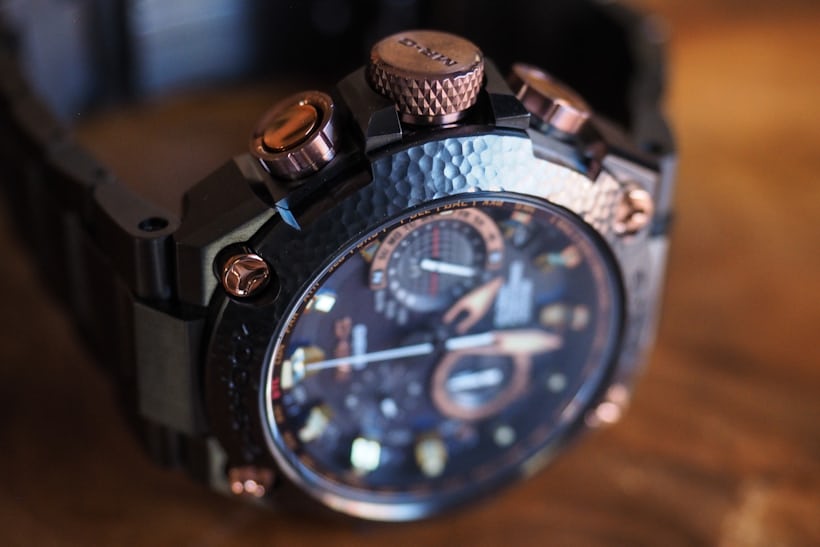
casio g shock hammer tone dial

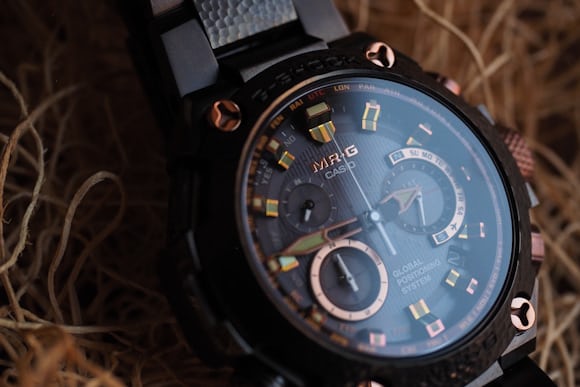
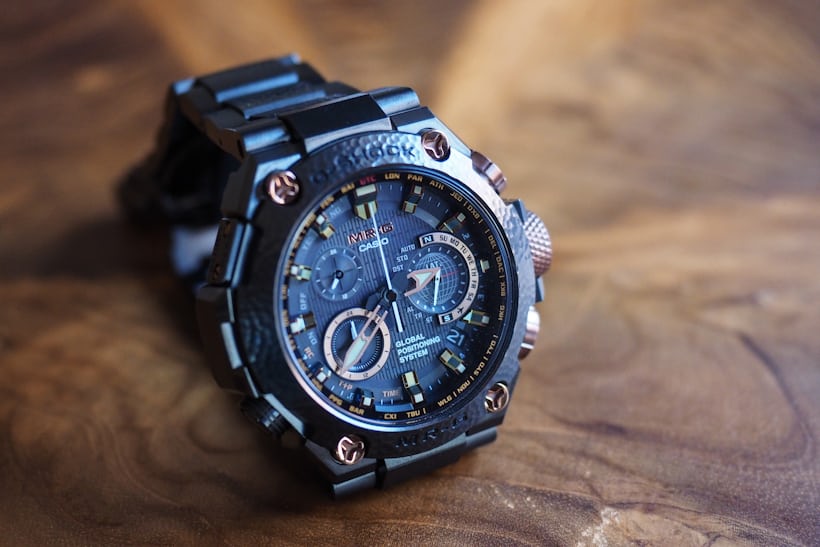
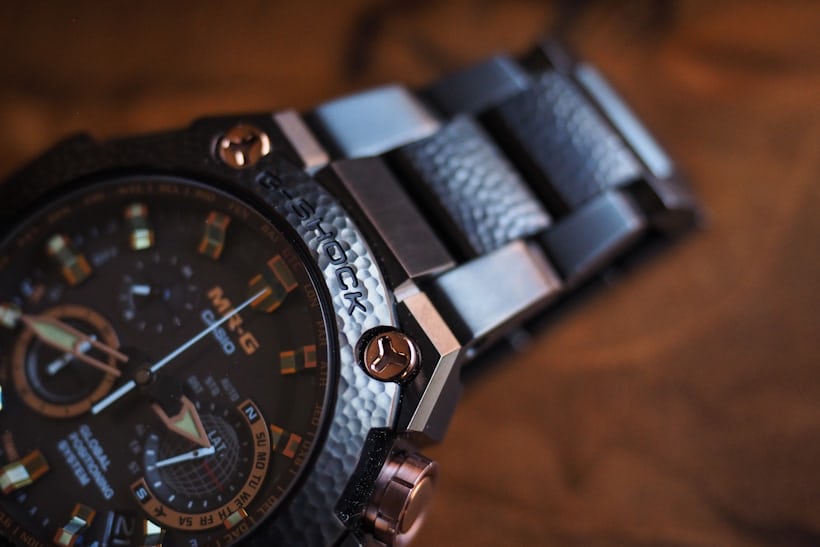
Before going any further into the decorative aspects of the Hammer Tone – designated MRGG1000HT – let's talk a little more in depth about its technical aspects. First of all, this is a G-Shock; the original G-Shocks were built to tolerate a 10-meter drop, have 10-bar water resistance, and have a 10-year battery life and this still remains the minimum standard for all watches that call themselves G-Shocks. The MRGG1000HT (HT for Hammer Tone) is based on the various MRGG1000 models, which are among the most technically advanced (and, for a G-Shock, the most expensive) G-Shock watches. Typically G-Shocks have used backlit LCD screens, but in recent years, Casio's been making them with analog hands as well, and the MRGG1000 watches have analog-only displays, which if you're a decades-long G-Shock user like me takes a little getting used to. Home time is shown on a sub-dial at 8:00; the main hour and minute hands show local time, and the dial at 10:00 shows 24 hour time.

The dial at 3:00 has several functions and depending on the mode you've selected, either shows the day of the week; the latitude at which you've taken your most recent time fix from the GPS system; whether or not the watch is in airplane mode; and whether or not you're set to summer or winter time. It can also function as a mode indicator, showing whether you're in alarm, stopwatch, or countdown timer mode.

One of the most interesting features of the Hammer Tone and the MRGG1000 watches on which it's based, is its use of the GPS satellite network to establish correct location and correct time for that location automatically. Of course the Hammer Tone isn't the only watch to use the GPS network for this purpose; the Seiko Astron and Citizen Satellite Wave watches both use the GPS network as well, but watches using the GPS system are still somewhat rare and technically very interesting. GPS watches work like any other GPS receiver: four satellites have to be in view in order for the time to be set correctly as three position coordinates are required, and one additional signal to compute the deviation of the clock on the ground from the atomic clocks on board the GPS satellites (which are themselves corrected by ground based atomic clocks). However, if the MRGG1000 watches are unable to obtain the time from the GPS system, they can use national time-broadcasting radio signals such as those found in Europe, the U.S., and Japan in order to obtain the correct time – and if all else fails, they are of course autonomous quartz timekeepers as well (and the Hammer Tone is solar powered as well).

casio g shock hammer tone dial closeup

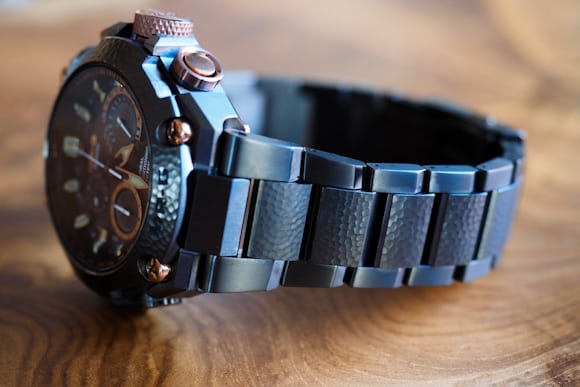
What really sets the Hammer Tone apart from any other G-Shock – and for that matter, from pretty much any other watch I can think of, period – is its use, not of conventional forms of horological ornamentation, and especially not of ones based in European cultural norms, but rather of decorative methods and materials that are native to Japan. We've gone over some of the details in our previous coverage of the Hammer Tone, but here's a recap: the watch is made largely of titanium, but with considerable additional work given to decorating it above and beyond anything Pharrell or Kanye might ever have imagined. The decorative technique is called tsuiki, and as we mentioned in our introduction to the watch some weeks ago, it consists of painstaking striking a metal surface with a hammer in such a way as to leave a pattern of tiny indentations (the technique is often found in traditional Japanese arms and armor). The technique creates a seemingly random pattern, yet despite its random nature it takes years of practice to be able to achieve the seemingly natural, artless effect – something intrinsic to much of the Japanese decorative arts from painting, to calligraphy, to ikebana (flower arranging).  

casio g shock hammer tone case flank

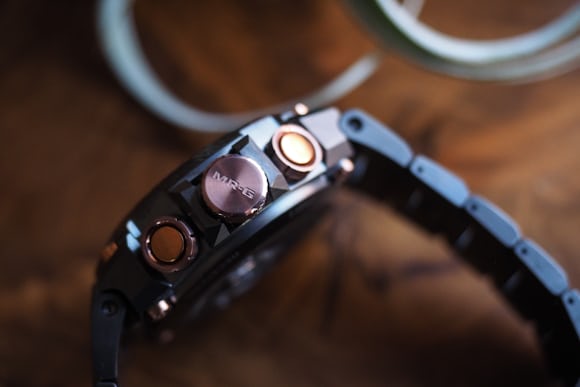
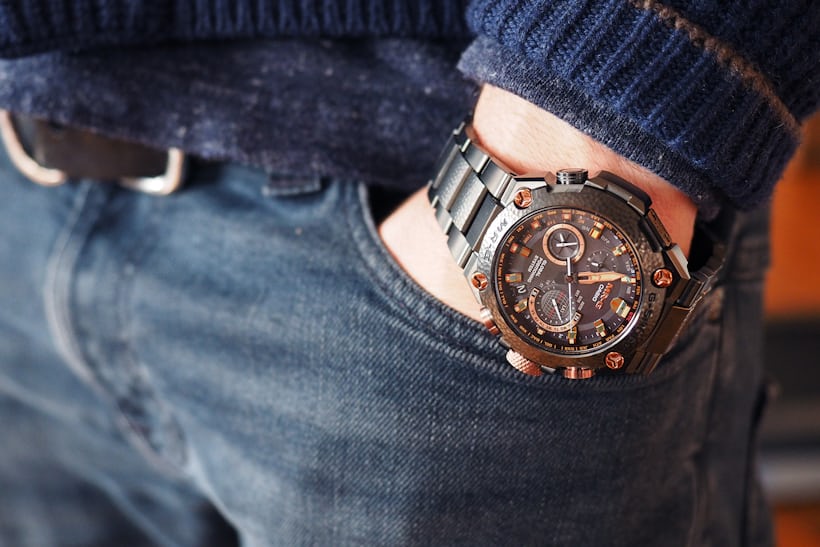
The tsuiki pattern (applied by tsuiki master Bihou Asano, who has created ornaments for the Kyoto State Guest House) is directly applied to the titanium bezel and center links for the bracelet, which are then hardened to make them 4-5 times harder than conventional titanium. The last step is to apply DLC coating to areas where a darker finish is desired, and a decorative metal coating to other areas. Most notably, the Hammer Tone uses oborogin, a silver and copper alloy; and akagane, a copper and gold alloy, to finish certain case parts, as well as the crown and pushers. Despite the rather hefty dimensions of the watch, and the impression you get at first that this is going to be a bulky affair in the hand and on the wrist, the whole watch is eerily light, thanks to the considerable use of titanium in its construction (and of course, the use of composites for the inner shock and impact shielding for the movement). As with all G-Shocks, the dial can be illuminated at night; since there's no LCD display to backlight, the dial is lit, rather theatrically, by a sort of LED footlight at 6:00.

casio g shock hammer tone closeup tsuiki

The Hammer Tone is an immensely confusing watch to encounter because it doesn't really fit in anywhere. There is a huge range of conceptual categories into which watches can fit, so as a rule we don't very often see a watch that refuses to seem appropriate for any of them, which makes life very difficult because the way most of us judge a watch is by how well it fits our preconceived notion of what any given type of watch should be. We all have our idea of what the ur-chronograph is, or the ur-dive watch, or the ur-dress watch (which is part of the problem with watch criticism from both specialist writers and enthusiasts; most of the time, without realizing we're doing it, we're really judging a watch on the basis of its adherence to our deeply held and typically, quite inflexible personal prejudices rather than evaluating it on its own terms).  

This is nominally a G-Shock, but it's obviously a tremendous departure from any produced to date (or at least, any series produced G-Shock to date) and it also resolutely refuses to fit any of the usual stereotypes of a blinged-out, low-end quartz watch, such as we've seen both in their more honest form (say what you like about gem-set Technomarines, at least they weren't pretending to be anything they're not) and in their more covert (any number of carelessly made and exorbitantly priced so-called ladies' watches, for instance). It also happens to be very well made; the technology is right now, up to the minute for an externally controlled quartz watch and in 50 years, given that it's a G-Shock there's an excellent chance it will still be running. Like all machines, it'll expire at some point but at least it will have the somewhat mournful appeal of once cutting-edge, obsolescent technology. More than that, it's physically made very well; both the tsuiki decoration and the machining of the case and other elements are, judged by the designer's apparent intentions, hard to fault.

casio g shock hammer tone bracelet closeup casio g shock hammer tone bracelet closeup 2

Japan, famously, or at least famously to Western and American eyes, is a place where incredible cultural extremes can coexist, and there's a profound commitment to the cultural identity to be found in its adherence to ancient norms and forms on the one hand, and an incredible fascination with technology and modernity on the other. Based on the reaction to our earlier introduction to the Hammer Tone (and the jolt of reading about a G-Shock that costs $6,200) I wonder if some readers mightn't think I'm pulling their legs a little bit with this review, but there's something, to me, deeply fascinating about this watch. What unifies every part of it is a certain single-mindedness – the pursuit of the most advanced timekeeping technology, the most exacting hand decoration techniques, the most visually and graphically striking design. It's nominally a watch, and nominally a G-Shock – and it'll perform well in both roles – but what it really is, is a collision of many different worlds brought together by a single obsessive fascination with what happens when you take seemingly completely divergent and even contradictory worlds to their extremes in one object. What you get is something that could have come from nowhere else than Japan, and probably, a watch that couldn't have come from anyone other than Casio.

casio g shock hammer tone bezel tsuiki

Read more about the MRG G-Shocks from Casio here.

For full specs and first impressions, as well as pricing, check out our First Look coverage of the Hammer Tone here.

Don't have the HODINKEE App yet? Get years of amazing watch content plus new stories, breaking news, and access to great new features like HODINKEE Live, free on iOS.

Introducing: Three New Divers From Oris – One Heritage Update, And Two Limited Editions Supporting Good Causes

Oris has been making watches bearing the designation “waterproof” since 1949, and started offering the Super Diver shortly after the Rolex Submariner (or was it the Blancpain Fifty Fathoms?) originated the genre in 1953. Left in the shadow cast by those two, Oris continued to make solid underwater timekeepers – with Kif anti-shock systems – trusted by professional divers around the world. With summer just around the corner, they've just launched three new dive watches – one heritage update, and two limited editions, proving that half a century later, they are still making strong diving instruments.

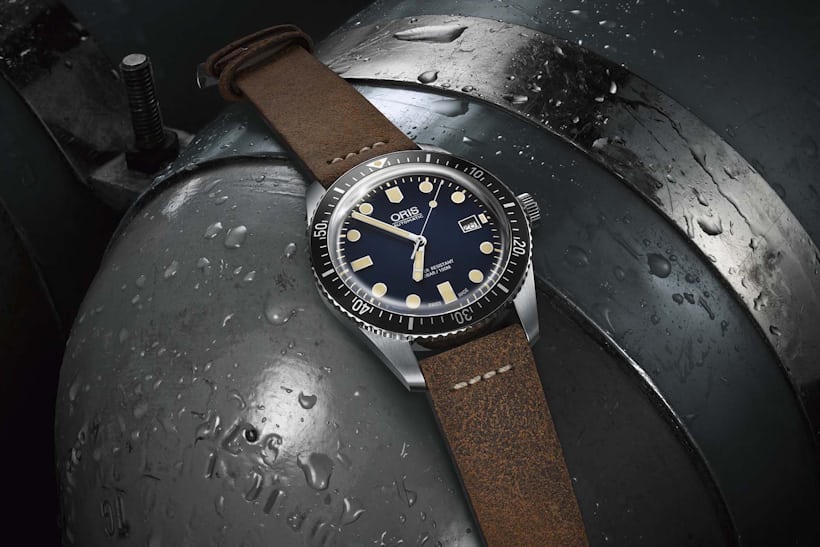
Oris Divers Sixty-Five watch

First up is the Oris Divers Sixty-Five. Based on a diving watch made by Oris in – you’ve guessed it – 1965, the Sixty-Five made a handsome return last year, when the company introduced this very cool retro-inspired diver. Then came a blue-dial version and a bronze limited edition dedicated to the U.S. Navy’s first African American master diver, Carl Brashear. In 2016, the collection continues to grow with a new model in a style suggestive of early dive watches.

Oris Divers Sixty-Five leather strap

In terms of design, the latest iteration has all the good things true divers, as well as more terrestrial beings, like about this kind of tool watch: a rotating bezel with a 60-minute timer, some large and legible hour markers, hands filled with Superluminova, and proven water resistance.

Oris Divers Sixty-Five case

While the color of the dial strongly mimics that of deep waters, water resistance for the new Sixty-Five is limited to "only" 100 meters. Oris still makes chunkier and more rugged instruments, with depth gauges and other tools meant for more technically oriented divers. And of course, it's worth pointing out that ISO 6425, the international standard for diver's watches, specifies 100-meter water resistance as the minimum – and of note as well is that recreational diving typically is limited to 30-40 meters.

The 42 mm stainless-steel case has a very attractive profile, with slim components and a retro bubble-curved sapphire crystal. A subtle but very cool throwback is the engraving of Oris emblem from 1965 on the case back of the watch.

Oris Divers Sixty-Five back

Inside, the watch is powered by an automatic movement based on a Sellita SW 200-1, with a date placed at 3 o’clock. All things considered, this is a sturdy timepiece, with good looks and interesting provenance. For the same price (the Oris Divers Sixty-Five is CHF 1,900), you’d be hardpressed to find better alternatives, though the Longines Legend Diver ($2,300) and the Tudor Heritage Black Bay ($3,100) provide some strong competition (as of course, do the under-$500 Prospex divers from Seiko). A large choice of straps is available for the Divers Sixty-Five, including a vintage-inspired leather strap and a water-friendly black rubber strap.

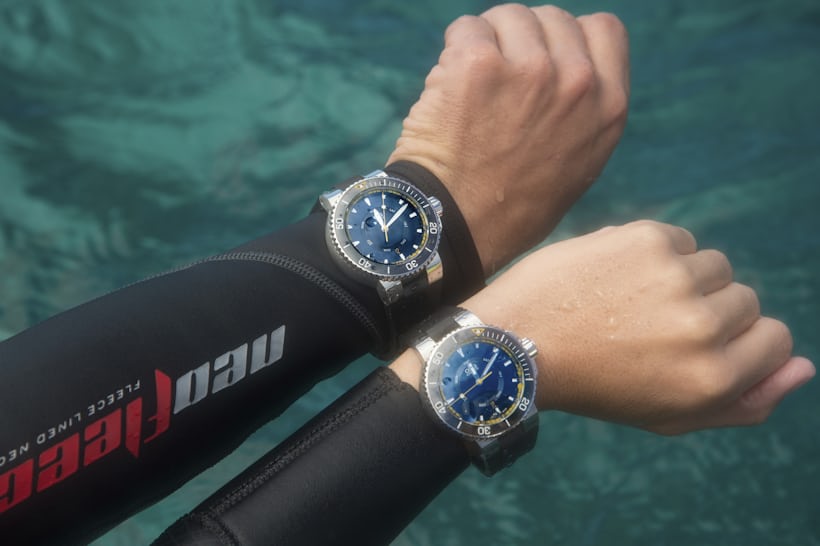
Oris Great Barrier Reef Limited Edition II

Next are two limited editions, both very different takes on the Oris Aquis, the go-to diver in the company’s catalogue. In Australia, Oris has partnered with the Australian Marine Conservation Society (AMCS) to help protect and preserve the Great Barrier Reef by funding the charity’s work through sales of the newly launched Great Barrier Reef Limited Edition II. A 46 mm day-date, the watch is made in stainless steel and is water resistant to 500 meters.

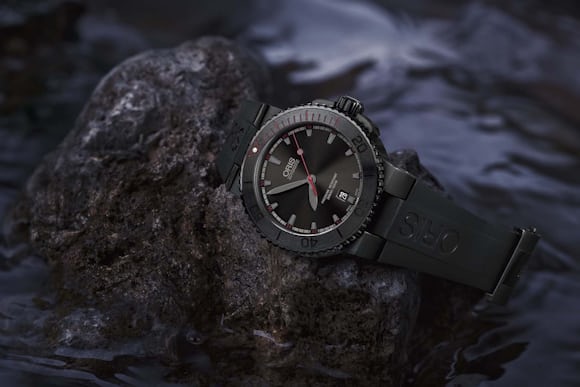
Oris El Hierro Limited Edition

In the Spanish Canary Islands meanwhile, Oris is backing the scholarships of three university students at the Faculty of Marine Sciences at the University of Las Palmas de Gran Canaria (ULPGC) to support their research of El Hierro’s submarine volcanic activity. The sombre watch, named after the volcano, is essentially a DLC-coated, limited edition of the Oris Aquis. The 43 mm dive watch is again powered by an automatic movement based on a Sellita SW 200-1, but this time, the date window is placed at 6 o’clock. It will be limited to 2,000 pieces, is available from May, and will be priced CHF 1,950.

Oris El Hierro Limited Edition watch

For more information, visit Oris online.

Don't have the HODINKEE App yet? Get years of amazing watch content plus new stories, breaking news, and access to great new features like HODINKEE Live, free on iOS.