Friday, May 6, 2016

Introducing: The (Incredible) Mechanical Marvels Collection At Sotheby's New York

As you may have noticed, it's auction season. Yesterday we picked our favorite watches from the Christie’s Geneva sale and today I bring you a sneak peek of what Sotheby’s has to offer in New York on June 8th. Along with a fantastic collection of watches for sale (more on those later), the sale focuses on a group of “Mechanical Marvels” – a follow up to last year’s June sale of a similar group of pieces, including a singing bird scent bottle made by Jaquet Droz that sold for approximately $2.5 million.

This sale features 20 mechanical marvels and we were able to take a sneak peek at the top three: The Fire Brigade, the Magician’s Box, and the Singing Bird Coffret.  These aren't watches, but automatons: mobile, mechanical devices made to provide astonishment and amusement.  They're unbelievably ingenious, and have a fascinating history – there are accounts of automata (many in the form of self-propelled robots) throughout history, and they enjoyed enormous popularity during the Renaissance, when some of the period's greatest artists experimented with them, including Da Vinci.  

Lot 86: The Fire Brigade, $300,000-500,000

One of the most complicated automatons to come to market, this snuff box, featuring a scene of villagers putting out a fire, is possibly a unique piece. It is attributed to Piguet & Capt., Geneva, and is from around 1798-1809. It has 12, yes 12, motions – starting with the woman on the right pumping the water, which is made of engraved glass, and ending with the six people rotating within the burning building. To see the piece in action see the video above.

lot 86 sothebys

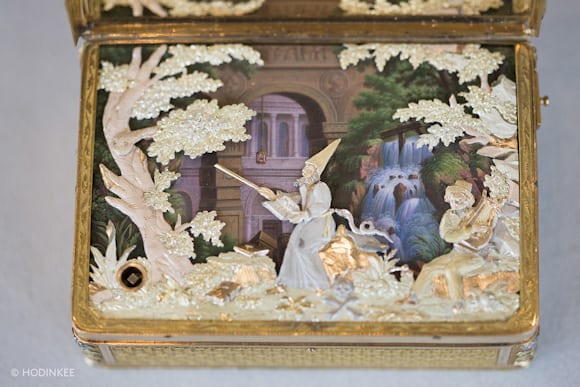
Lot 81: The Magician’s Box, $1,500,000-$2,500,000

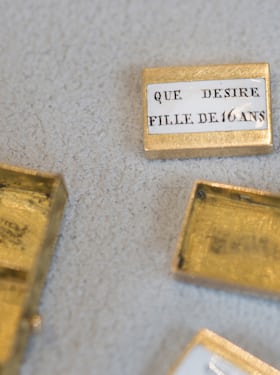
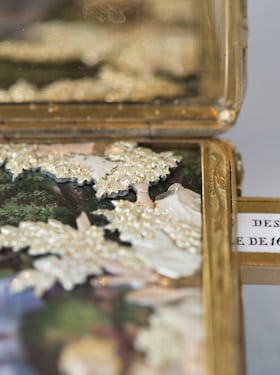
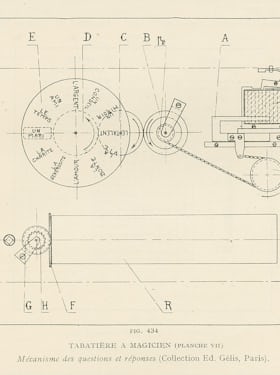
The highlight of the sale, this Magician’s Box is incredibly rare and cool. Attributed to Piguet & Meylan, this intricate snuff box, made of yellow gold and enamel, captures the essence of the time with its magician-themed automaton. Here's how it works: you place one of the 10 tiny enamel questions into the side of the box and after winding it, the box begins to play music while the magician waves his wand. At the end of the song, the tree branch on the left-hand side moves down to reveal the answer. The example we chose was, “What does every 16 year old girl want?” The answer? "A husband." (Oh how times have changed.) These pieces are incredibly complicated and are best seen in person (though you can get a solid idea in the video above).

This is one of only six known Magician’s Boxes that have come to market. For more information on how it works, click here. It's, you know, magical.

lot 81 sotheby's lot 81 sotheby's From "Le Monde des Automates," by Alfred Chapuis and Edouard Gélis. (Images courtesy of Sotheby's)

Lot 82: The Singing Bird Coffret, $400,000-600,000

Lot 82 sothebys

One of five known similarly shaped boxes, this gold and enamel singing bird box from 1800 exemplifies incredible enamel-work throughout. The main thing to note about this singing bird box is that the bird remains upright even when the box is closed. The mechanism for this is attributed to Jacob Frisard, who back in the day was kind of the Elon Musk of singing bird mechanisms. Additionally, the case enameling is by Moulinié Bautte & Co., who were the best bijoutiers horlogers in town back in the 18th century. Click here for the full catalogue description.

For more of these mechanical marvels, check out the full flippable catalogue online here. In addition to these lovely little pieces there are hundreds of modern and vintage wristwatches to choose from. The sale will take place on June 8th in New York City.

Bring a Loupe: Beautiful Vintage Chronographs From Mido, Gallet, Heuer, And More Found On EBay

This Bring A Loupe will be dedicated to chronographs; this is not the first time, but we found too many cool listings on eBay to not make it the focus of this week. The usual suspects are there, from an oversized UG to a transitional Heuer Autavia. But we also present some more under-the-radar picks, such as a Mido Multi-Centerchrono, a Gallet MultiChron Navigator, and a blue-dialed Enicar Aqua Graph. This is your Bring A Loupe for May 6, 2016.

A Mido Multi-Centerchrono – A Chronograph In Disguise

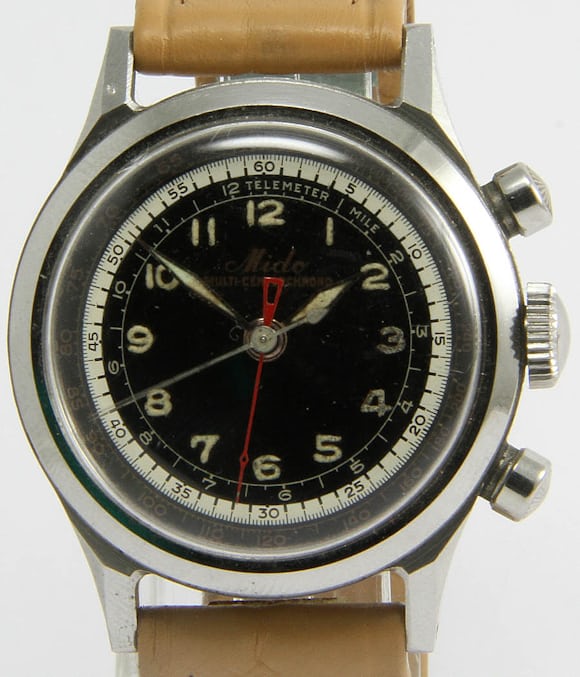
Mido Multi-Centerchrono

"Here is the only chronograph that looks like a handsome watch." The original advertising tagline for this Mido was sharp but on point. The chronograph function is indeed centralized, rather than displayed through the usual sub-registers. Therefore, the thin steel hand tracks the second, while the red one records the elapsed minutes, with the relevant tracks on the outside of the dial. And the result is striking: this Mido achieves an incredible legibility for its 35 mm diameter. You might have also recognized the sunburst engraved pushers from Patek's first waterproof chronograph (the reference 1463); and indeed, both cases come from the same casemaker, François Borgel. Inside the Multi-Centerchrono is the very interesting caliber 1300, based on the illustrious Valjoux VZ, which was also adopted by Patek and Audemars Piguet, among others.

Mido Multi-Centerchrono movement 1300

A German dealer is offering this unusual chronograph here (price on request).

A Gallet MultiChron Navigator – A Chronograph With A GMT-Hand

Gallet MultiChron Navigator

There is much to love about Gallet's chronograph, and even more about the MultiChron Navigator GMT, a true tool watch from the 1940s. The watch is not a "simple" chronograph, as it also features a 24-hour GMT hand, much like the one you will find some 10 years later on the Rolex GMT-Master. Interestingly, the red hand can also be used as a compass during daylight: you point the regular hour hand to the sun, and the red hand works as a compass, pointing north. Furthermore, the second hand can be hacked (meaning stopped), which allowed military personal to synchronize more precisely prior to a mission. All technical details aside, the watch looks killer with a beautiful dial, nice patina of the lume, and a well preserved 35.5 mm case. In short, this is a really interesting watch, housing a modified movement from Excelsior Park, a renowned maker for chronograph calibers at the time.

This fantastic Gallet is offered on eBay here; at the time of publishing bidding was still below $3,000.

A Heuer Autavia Reference 3646H, With Transitional Configuration

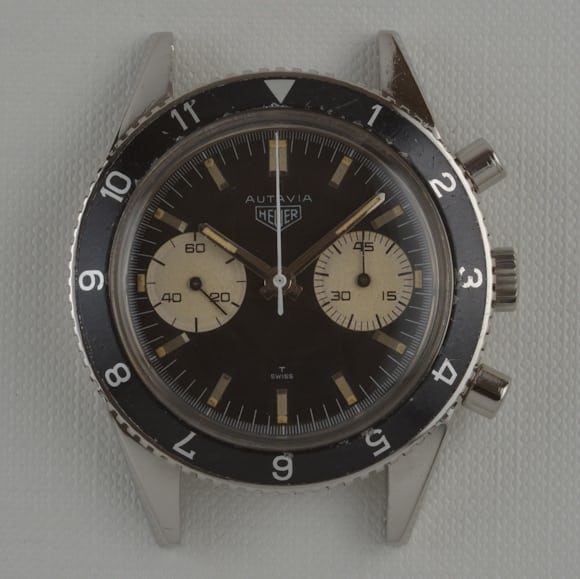
Heuer Autavia 3646H

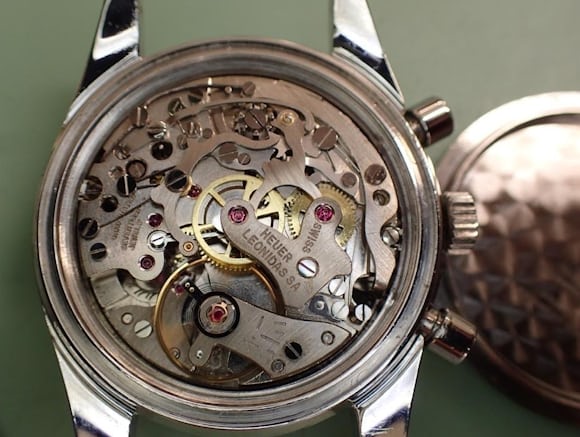
Unsurprisingly, an early model recently won the Autavia Cup that we had covered here; it confirmed the love for this chronograph line, even outside of the circle of hardcore Heuer collectors. The winning watch, found here, was actually a reference 2446 Mark 3, looking very similar to the vintage Autavia above, if it were not for its three-register layout. The reference 3646 was indeed a contemporary of the 2446, without the lower hour counter. And the example here offers the beloved bezel tracking the hours, as well as a typical Mark 3 dial with larger indexes. It still comes with a screw-back case with bevelled lugs but it retained the earlier larger bezel. Its serial number actually confirms the transitional status described in a thorough article here. Note that the seller discloses that the hands have been re-lumed to match the the dial's patina, and the second hand repainted. On the plus side, the Valjoux 92 movement was recently serviced and comes with a one-year warranty.

Heuer Autavia Valjoux 92

You can find this Autavia on the dedicated marketplace ChronoTrader here, and the seller is taking offers above $8,000 until Sunday.

An Enicar Aqua Graph With A Rare And Attractive Blue Dial

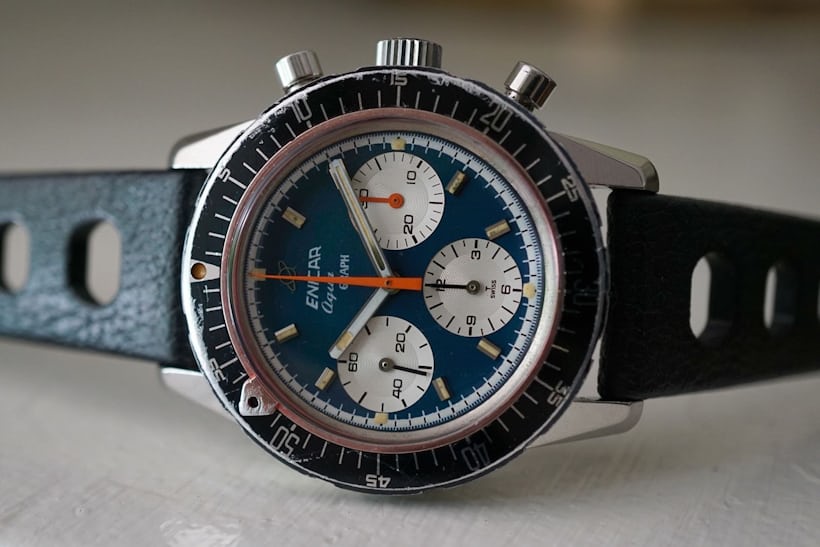
Enicar Aqua Graph Blue

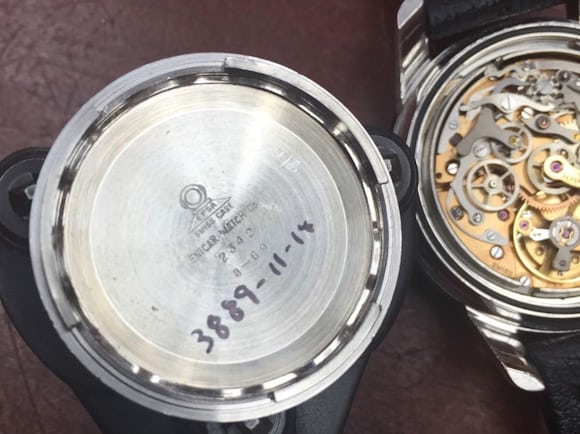
I had been following this Enicar, successively offered on Instagram and on forums, so I was pretty excited to see it finally appear on eBay. This is not the first Aqua Graph we've looked at in Bring A Loupe, so its cool look does not need much explanation. That said, this one offers a very enticing blue dial that nicely contrasts with the orange hands. According to the seller, this dial was offered in the later version of the Aqua Graph, dating this one to the late 1960s. This is confirmed by the case back, also indicating Piquerez as the manufacturer for this compressor case – as it should.

Enicar Piquerez Compressor You can find this blue Aqua Graph listed on eBay here; at the time of publishing bidding was just above $3,000.

A Yema 'Daytona' With Valjoux 7730

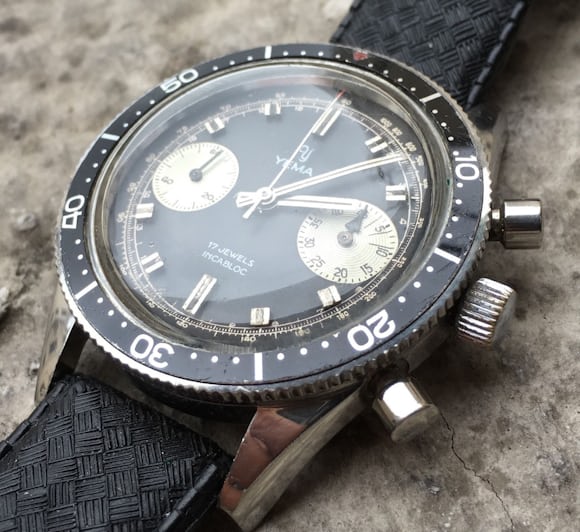
Yema "Daytona"

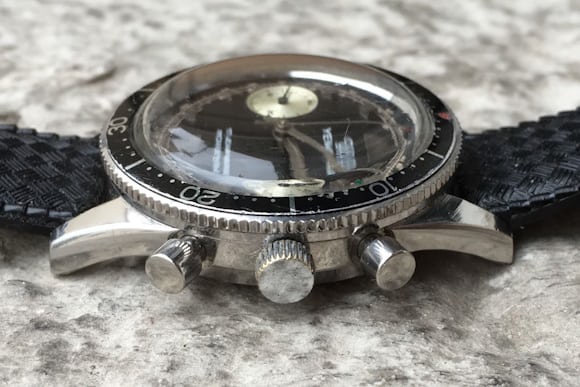
The French company Yema is more well known for its Yachtingraf and Rallye/Rallygraf, but this 38 mm chrono deserves some recognition too. The"Daytona" nickname – a bit ambitious, but also a commonly used one for this watch – was based on the thin grounds that, well, this chronograph had a black bezel and contrasting sub-registers on the dial. Never mind that the dial only featured two registers, and that the handset and bezel were noticeably different in style, my French compatriots were feeling generous and the name remained. The Yema "Daytona" line was launched in the mid-1960s, initially with a Valjoux 92, and two years later with the caliber Valjoux 7730, as the example here listed with a tropic strap, and coming with a replacement crown.

You can find this French chronograph listed on eBay here with bids still below $800.

(Almost) Notable Sale Of Past Week: An Oversized Universal Geneve Compax Reference 22430 That Put EBay On Fire

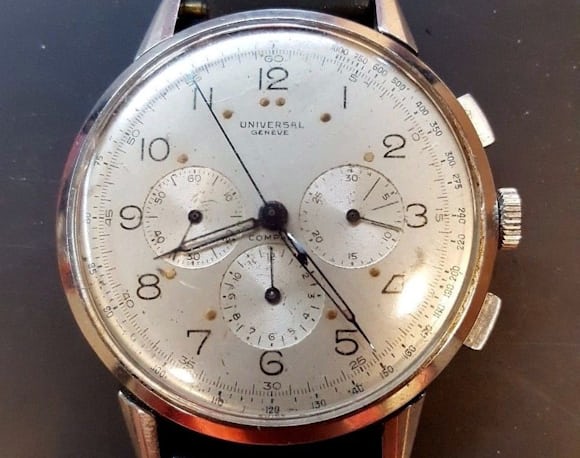
Universal Geneve Compax 22430

It all started as a very exciting listing that no one really missed. Within the first hours the bids had risen from the initial $19.99 price to more than $17,000! It would have been really interesting to see where it would have ended; unfortunately the listing was pulled yesterday. The good news is that this oversized Universal Geneve – think a colossal 46 mm diameter, a crazy dimension for the 1940s – was not bought behind the scenes, but will likely be featured later in a standard auction. So we will be on the lookout, and report the final selling price. The dial is not perfect, and the hands have lost their lume, but you've got to love the sheer size of this Compax reference 22430, and its characteristic lume dots near the numerals.

You can find the link to the original listing here, and you will probably see this attractive chronograph popping up at an auction soon.

Thursday, May 5, 2016

Hands-On: Grape Flavored Oyster: The Rolex Oyster 36 With Red Grape Dial

"He patted Smiley on the shoulder: 'Maybe you should have more fun in life.' 'Maybe I should have done,' Smiley agreed."

– Smiley's People, John le Carré

The Rolex Oyster 36 came out in 2014, and was, almost immediately, taken for granted, which if you stop and think about it, is in a funny way a compliment to the watch. No one gets on a five-year waiting list for the Oyster 36; no one sputters in indignation about the font; no one says they'd eagerly knife their own mother to get one. It's simply a very solid watch, and since its whole identity is to be the paradigmatic everyday watch – reliable, classic, versatile, accurate, and dependable; the sort of thing an actual spy might wear, especially the sort whose stock in trade is to go unnoticed – flying under the radar is sort of exactly what it's supposed to do. But like so many steady, steadfast things in life, there's a lot of dignity and even beauty in the Oyster 36, if you pay attention.

Rolex Oyster 36

This is one of those watches about which on a certain level, there is not a whole heck of a lot to say. It's about as stripped-down as a Rolex gets – no complications, no sub-dials, plain-Jane stainless steel, and at 36 mm, it's a little on the conservative side. You wouldn't call it exactly a small watch, but God knows it's not assertively large, either. There is nothing especially eye-catching about the design; the steel finishing is good, solid steelwork but nothing to evoke the usual hyperbole we watch writers usually trot out when we see a brushed surface hard up against a polished one (gorgeous contrast! stunning alternation! Brancusi-esque!).  

The movement's certainly a solid one, and a reminder of just how much more you get from Rolex at this price point chronometrically than you do from virtually all their competition: the manufacture caliber 3130, chronometer certified, with Parachrom balance with Breguet overcoil, adjustable balance bridge, and free-sprung balance with Microstella balance screws for adjustment of rate. It's a top-notch engine that keeps an extremely close rate, but you'd never know it looking at the watch from the outside. In some Rolexes, the RolexRolexRolex on the rehaut (inner bezel) seems a proud declaration of luxury status; here it has all the opulence of a fence topped with concertina wire. Its sole purpose is to say counterfeiters not welcome.

Now if you want a version of this watch that has all the understated, just-the-facts-ma'am, poker faced, Joe Friday quality for which so many Rolexes are famous, you can have this watch in steel with a grey dial and you won't have a moment's regret; you'll own a watch you can look at every day for the rest of your life, with a fantastic movement that's all sorts of bang for the buck, that will give you all the pride of ownership you could possibly ask for in a mechanical watch. But why not have, you know, a little fun.  

Somewhat miraculously, you can get the Oyster 36 in several rather frisky dial colors, and I personally happen to very much like Red Grape. The color is pretty seductive – the deep garnet of that first full glass of wine that promises the unwinding of the day's tendrils of care and if not a roisterous, at least a relaxing evening ahead. But to be honest I think that a big part of what I like about the watch in Red Grape is the name Rolex has given to the color – Red Grape Rolex; you can't say it without smiling (well, you probably can but you probably have to work at it a little).

It comes in White Grape, and Blue, as well, but blue is a little too easy to like these days and in general I find yellow dials a little jaundiced. No, Red Grape it is, for just a little injection of the Dionysian in your otherwise by-the-book wristwatch.

At $5,050 it's one of the nicest Red Grape flavored wristwatches out there. Go ahead, let yourself go and have a little fun. It's too late for George Smiley, but it's not too late for you.

The Rolex Oyster 36, 36 mm in steel, Oysterlock clasp and 904L case and bracelet. Screw-down crown, 48-hour power reserve, water resistant to 100 meters. Read all about the Grapest of watches right here on Rolex.com.

Don't have the HODINKEE App yet? Get years of amazing watch content plus new stories, breaking news, and access to great new features like HODINKEE Live, free on iOS.

Hands-On: That Insane Patek 530 Sector Dial Coming Up At Christie's Geneva

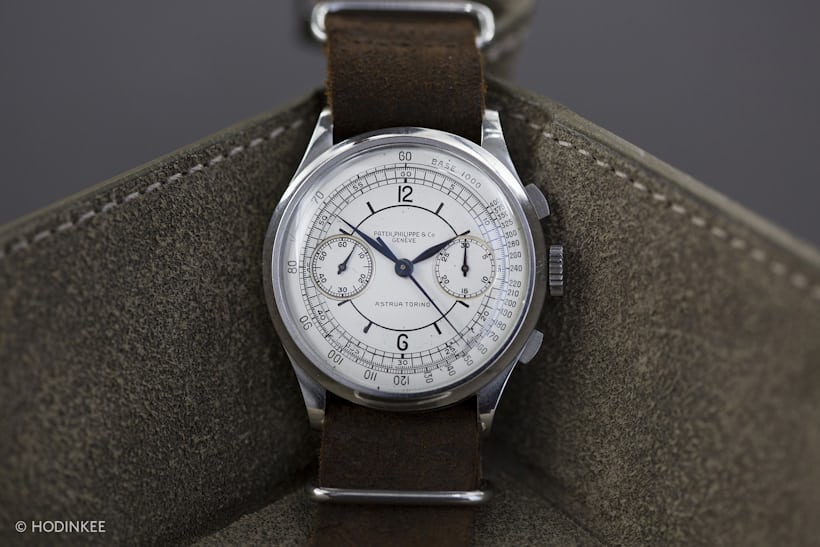
Okay, you knew this was coming. Back in March, we announced that Christie's would be selling the earliest known steel 530, and oh, by the way, it features a sector dial, is signed by Astrua, and is in great, original condition. Well, we got to see it just this week in New York, and man, is it a beauty. Let's look a little closer.

First, what is the 530? The 530 is the rarest production reference of chronograph from Patek. If you consider the 130 the basic PP chronograph, the 1579 the dressier chrono, and the 1463 the sporty, waterproof chrongraph, the 530 is basically an upsized 130. But it's way up-sized, and it's spectacular.

The average 530 is 36mm, with a thin, flat case and thin rectangular pushers. Inside is a Patek finished Valjoux 23 caliber, barely recognizable after all the hand-work done to it by Patek in its prime. 530 chronographs come with two different cases, one with 19mm lugs, the other with 21.5mm lugs. Oh, and sector dial, steel 530s? Yeah, they're actually .5mm larger still.

Any 530 is a special watch, a steel one more so, a sector dial steel one is about as good as you can ask for. Then, when you consider that this watch was basically unknown to the collecting community – in the same collection for four decades before being offered in this auction and moreover, never written about or in any book – and in fantastic, original condition, you begin to see why this watch is making so many waves in the Patek world.

The watch is not unpolished, nor is the dial flawless, but it's incredibly honest and original. Notice the "Patek, Philippe & Co" long signature still retains commas, and the accent over the "E" in "Geneve" is still present. This is a quick and dirty way to examine if an early dial has been washed or restored, and here, it looks great.

Down below, the "Astrua Torino" signature is deep, and the sector markings are crisp and true. There is a smudge, however, at the 7 o'clock marking, and some printing by the 25 minute marker is faded – the same true at 35.

While the watch is not what we'd call "mint", this is about as good and honest, and exceptionally rare watch as you are going to find. Compare it to the last 530 steel chronograph sold by Christie's (lot here, live pics here), and you can see how much better this dial is. Oh, and at the time, we thought that watch may have been the earliest known steel 530 in the world. We know that is not true, now. By the way, that watch sold for $612,000 then, with a dial that wasn't nearly as nice as this one. Also, even next to the other steel 530 available this month (at Phillips here), you can see how more original this dial is, not to mention its desirable configuration. On the wrist, as you see above, the steel 530 wears like a modern watch, and may in fact be one of the most desirable, rare, early 20th century Pateks in the world. This one, dear friends, is going to fly.

Christie's has an estimate of $500,000 to $800,000 and I've heard from several world-class collectors that they have their sights set on it (though not all!). Click here for more details and if you're in NYC, be sure to head to Christie's to check it out in the metal.


Don't have the HODINKEE App yet? Get years of amazing watch content plus new stories, breaking news, and access to great new features like HODINKEE Live, free on iOS.

Ultra Thin: What It Is, Why It Matters, And Who Does It Best (Part 2)

(Above, the Piaget 20P/Lassale Caliber 1200, the thinnest hand-wound movement ever made.)

In Part One of this story, we looked at the history of ultra thin watchmaking – at why the earliest watches were so thick, and how advances in watch movement design, combined with the evolution of modern clothing styles, drove the development of thinner watches. We also looked at how and why ultra thin watches became, not only fashionable, but also came to be seen as a manifestation of the highest level of skill in watchmaking. Today we'll take a look at exactly why making an ultra thin watch is considered such a challenge – as well as at some of the ways in which modern fine watchmaking houses continue to develop the art.

Above is the JLC caliber 849. This is one of the classic ultra thin movements of the 20th century, and at 1.85 mm thick, it's an excellent one to look at in terms of why making thin movements is so challenging. There are a number of reasons it's harder to make a very thin watch, and make it work well, than it is to make a thicker watch. First of all, there's the question of power. If you want a watch to run accurately, it's essential to have adequate power fed through the gear train to the balance wheel, so that it can oscillate at a large enough amplitude (amplitude just means how much the balance swings, and is generally expressed in degrees) to maintain accuracy across the working power reserve of the watch. The amount of power you can get from a mainspring is generally dependent on the height of the spring, and of course, in an ultra thin movement there is considerably less height available. That means that the movement has to be made and assembled very carefully and precisely, in order to avoid excessive loss of power due to friction.

Another reason it's challenging to make a very thin movement is that as a rule, you have to make significant changes in movement architecture. As an example, in most watch movements, the mainspring barrel has two pivots – one running in a bearing in the mainplate, and the other in a bearing in the barrel bridge. The JLC caliber 849 has what's called a "hanging" barrel (which was originally invented by Lépine, who you'll remember from Part 1 of this story). A hanging mainspring barrel has no upper bridge; instead, it runs only in one pivot: the one in the mainplate. The construction is inherently less stable and again, requires a lot of care in manufacturing and design to work well, but getting rid of the upper barrel bridge saves precious millimeters and is essential, in the 849, in bringing in the height at under 2 mm.

Now let's take a look at a modern self-winding ultra thin movement. Above is the Audemars Piguet caliber 2121. (The simplest version of this movement is the caliber 2120, which omits the date wheel; the 2120 is 2.45 mm, and the addition of a date wheel adds to the height only slightly, bringing it up to 3.05 mm.) This movement was first produced in 1967 and at the time it debuted, it was the thinnest full rotor movement in the world. Like the JLC caliber 849, it's significantly different in many respects from a conventional self-winding movement, including its use of a hanging (or as AP calls it, a "suspended") mainspring barrel. One of the most interesting features of the caliber 2120 and its variants is the suppression of the thickness of the oscillating weight, by moving most of its mass to the periphery. The problem with this strategy is that the weight isn't very stable and in the 2120, there is an ingenious solution: the weight is supported by ruby rollers on its underside, which run in the circular rail you can see at the edge of the movement.


An interesting feature of the caliber 2120 and variants, is that despite its slim profile, it readily supports complications, such as a perpetual calendar. Below is the caliber 2120/2802, dial side – a perpetual calendar movement, as seen in the Jules Audemars Perpetual Calendar.

Now, the caliber 2120 (which is used today by Vacheron Constantin as the caliber 1120 as well) is the thinnest full rotor self-winding movement in the world, but there's a way you can trim even more height, and that's to use a micro-rotor. The advantages of the micro-rotor are obvious – the winding weight is in the movement, not on it. The problem is that because the diameter of the winding weight is much smaller than it would be in a full rotor movement, there's a major leverage disadvantage, so again, it takes very careful design, manufacturing, assembly and adjustment to get acceptable performance. One of the most impressive achievements in the use of a micro-rotor in an ultra thin movement was the introduction by Piaget (a name that's practically synonymous with ultra thin watchmaking) in 1960, of the caliber 12P.  

Caliber 12P is only 2.3 mm thick and even today, it would be an impressive engineering feat – in 1960 it was an incredible accomplishment and did a lot to secure the reputation of Piaget as, in some respects, the watchmaking firm when it comes to ultra thin watchmaking – and this at a time when "elegant watch" would almost universally have been agreed to be three things: thin, gold, and automatic.

Movements like the calibers JLC 849, the Piaget 12P, and the Audemars Piguet 2120/Vacheron Constantin 1120 probably represent a certain practical limit on how far you can push ultra thin watchmaking using conventional materials. Attempts to go even further did not end well, in general.

Above is the 1.2 mm thick  late (and largely unlamented) Jean Lassale caliber 1200, from 1976. In its time it was a technical miracle, and unfortunately, it was a mechanical technical miracle – thanks to the advent of quartz technology – produced at an inauspicious time for a new mechanical movement of any kind, much less a small, incredibly thin, and incredibly problematic one. By 1979 production (by Bouchet-Lassale, named for founder Jean Bouchet-Lassale) had ceased production. The name Lassale was bought by Seiko, who put it on the dials of ultra thin quartz dress watches, and the patents were bought by Nouvelle Lemania, who continued the production of the hand-wound caliber 1200 (and ultra thin Lassale automatic caliber 2000) for a few more years before production eventually ceased. Piaget used the Lasalle 1200 as the Piaget caliber 20P, which is the version you see here; Vacheron Constantin also used it, as the Vacheron caliber 1160, and how they managed to get Geneva stripes on them is a matter of wonder; you'd think there wouldn't be any surplus metal left to remove.

Alas, for Jean Lassale, the problem wasn't just bad timing; the movements were simply too thin to be reliable. The movements were so thin that they could be irreparably damaged just by opening the watch case and at both Vacheron and Piaget, servicing the watches when they came in often meant simply discarding the movement and installing a new one. The extreme thinness was achieved by putting all the train wheels in the baseplate itself – since there were no bridges, not only the mainspring barrel but all the gears as well, were "hanging" and had to be supported in ball bearings. This is generally a bad idea for watch movements, as the bearings can introduce undesirable variations in power flow. But it was a bold design, if ultimately doomed.

In our next installment, we'll look at how some of Lasalle's ideas, and other ingenious concepts, eventually bore fruit, and how modern watchmakers are using cutting edge manufacturing methods to take some initially unsuccessful ideas and turn them into resounding successes.

Check out Part 1 here.

Don't have the HODINKEE App yet? Get years of amazing watch content plus new stories, breaking news, and access to great new features like HODINKEE Live, free on iOS.

Editor's Picks From The Upcoming Christie's Geneva Auction

The ongoing battle between Phillips and Christie's has produced some fascinating behind-the-scenes narratives, but to the rest of us, the result is nothing but better scholarship and increased availability of absolutely superlative watches. We've already told you about our team picks at the upcoming Phillips auctions (click here to read, and here to read about some amazing pocket watches coming from AQ), so today we're here to give you an idea of what our team is into from the Christie's May 16th Geneva sale. The theme? Mid-century complicated wristwatches.

Jack's Pick: Patek Philippe Dual-Crown World-Timer Reference 2523/2
Christies Geneva Patek Philippe Reference 2523

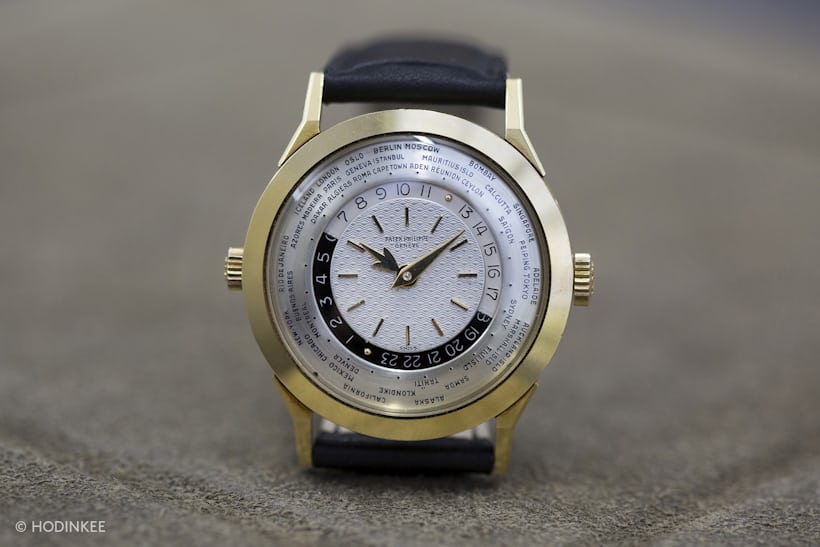
Patek Philippe is strongly associated with certain complications – the perpetual calendar, for instance, and that, so much so that when they produced an annual calendar it provoked considerable indignation. But of all the complications Patek makes, it’s probably the world-time complication, which was first developed in its modern form by the watchmaker Louis Cottier in 1931) and produced by him for Patek for many years, that’s the defining complication for Patek (see this year's Basel release). Cottier also made world-time movements for other clients, including, of all things, Rolex (a small series of pocket watches, Rolex reference 4262) and his first Patek world-time watches date to 1937. While world-time watches and clocks with the names of reference cities around the world date back considerably further than you might think (there is, for instance, a world-time clock by Hans Neidtner, of Hamburg, which was completed around 1630 and which, aside from the font, has a world-time 24-hour dial that’s surprisingly modern looking), it’s Cottier’s designs that really define the complication, and especially those he made for Patek Philippe.

Of all the Patek Cottier-made world-time references, the two-crown variations are the rarest and by far, the most costly to acquire; references 2523 and 2523/1 can, on the rare occasions they come to market, easily list for estimates between half a million and three quarters of a million dollars. Some can hammer for even more than that, like the enamel dial 2523 that Christie’s listed in 2014 that went for a cool CHF 2.3 million. Cottier completed the first two-crown world-time watch in 1950, and the first use of it by Patek Philippe was in the reference 2523 in 1953.
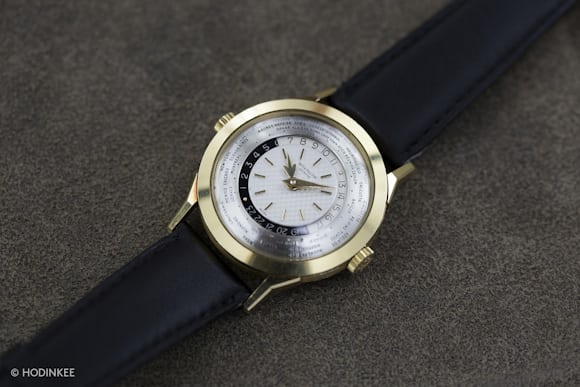
Lot 117 from this sale is a wonderful example of one of the last series of Cottier movement 2523/1 watches, and while not entirely fresh to market, it has been in the collection of the current consignor since he purchased it from Christie’s in 1998. As with any high value, low production vintage watch, condition is everything (or almost everything) and according to the lot notes, thanks to the very short chain of custody, this world-time reference 2523/1 is in incredibly well preserved condition. The watch, according to the extract from the Patek archives, was completed in 1965 and sold to its first owner in January of 1973. There have been only two owners; the current consignor, and the first owner.

As you might expect, the estimate on this lot is very high, but as is so often the case with very rare Patek Philippes it’s entirely possible for the watch to go much higher than the high estimate; references 2523 and 2523/1 are so rare and so desirable – and in this condition, even more so – that it requires only a couple of serious collectors with deep pockets (or interest from the Patek Museum) to drive the price sky-high. This is a lot to watch with considerable interest even if you’re not bidding on it (as most of us will not) as the hammer price, as well as the vigor of bidding activity, for such a rare and perennially sought reference, is a significant indicator of the strength of not only the vintage Patek Philippe market, but also of the vintage market as a whole.

Click here for more on the Patek Philippe 2523/1.

Arthur's Pick: Breguet Triple Calendar
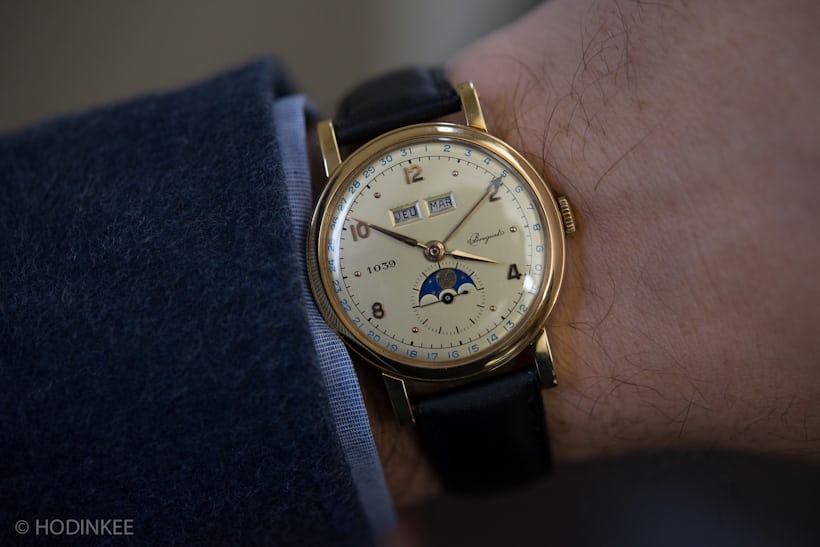
Christie's Geneva Breguet Triple Calendar

It was not Abraham-Louis Breguet’s pivotal role for the craft, nor my patriotic instincts that drew me to the French watchmaker, but the words of a Russian poet.

“A dandy on the boulevards . . . strolling at leisure until his Breguet, ever vigilant, reminds him it is midday.” – Alexander Pushkin, 1829.

Pushkin identified, as many of his contemporaries did, that a Breguet was, above all, a precious object that young men should aspire to own one day.

Needless to say, there are many pieces that fall under that distinction in Christie’s upcoming Geneva sale. However, for the reasons stated above, this Breguet calendar is my highlight.

Presented in an 18k yellow-gold case and signed n°1039, this triple calendar looks like a lot like other triple calendars made in the post-war years – most notably because of the blue outer date ring.

However, while its peers manufactured many during that era, Breguet’s production focused on other complications. In fact, Breguet’s own archives suggest that only five of these were made, and the condition of this particular model, whose dial has veered slightly from pink gold to a most beautiful champagne, makes it all the more desirable.
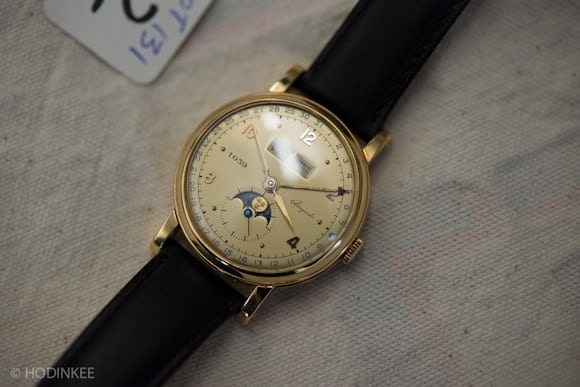
I mentioned earlier that French pride played no part in my selection, and I stand by that remark. Though I would be lying if I said the French calendar does not add to the charm of this watch.

And while the complication is one that speaks to me – I picked a Rolex yellow-gold "Stelline" reference 6062 not so long ago as one of my Phillips highlights – it’s the finer details of the dial that place this Breguet above similar watches in the Christie’s catalogue. I'm thinking especially of the combination of applied gold dots and applied Arabic numerals, as well as the balancing act between the name of the manufacture, and the production number of the watch. Another striking feature are the alpha hands, which look like spearheads. They are a very unusual sight in vintage Breguet.

Petite might be the best way of describing the presence of the watch on the wrist. The case measures 35 mm and it doesn’t wear much larger, though the thin lugs extend the overall size of the watch.

It’s never easy to choose a single favorite from Christie’s annual Geneva lineup, and even harder to predict whether bidders will abide by the auctioneer’s estimates, or fight it out whatever the cost. But I expect this rare and very attractive watch will light a spark in the room come May 16th.

Click here for more on this very rare triple calendar from Breguet.

Louis' Pick: Rolex GMT-Master 6542 With Tropical Dial
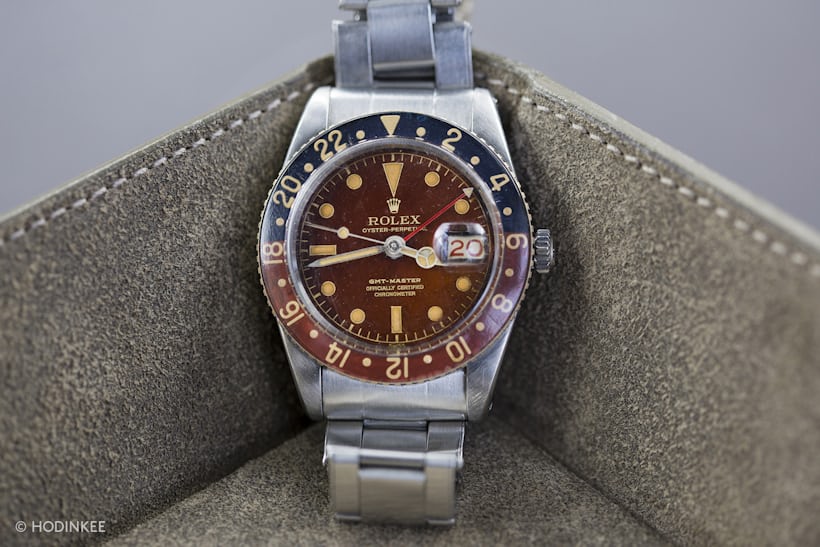
Christie's Geneva Rolex GMT-Master 6542

My choice of an aged tool watch from a catalog filled with wonderful perpetual calendars might be perplexing for some. Yet, during the showing at Christie’s I couldn’t let go of this early GMT-Master. There was something extremely compelling about it; the tropical dial is nothing short of magical, with an intense brownish hue that is really to die for. It matches the lower part of the bezel as much as it makes the patina of the lume look even better.

On the wrist, this GMT-Master easily proves that Rolex's first foray into travel watches was a masterpiece; the 38 mm case feels perfectly proportioned, without crown guards in the way. And very importantly, the watch has retained its bakelite bezel, the Achilles’ heel of this reference. This part is indeed as fragile as it is beautiful, and the acrylic substitute lost both the sexy looks and the poetic weakness.
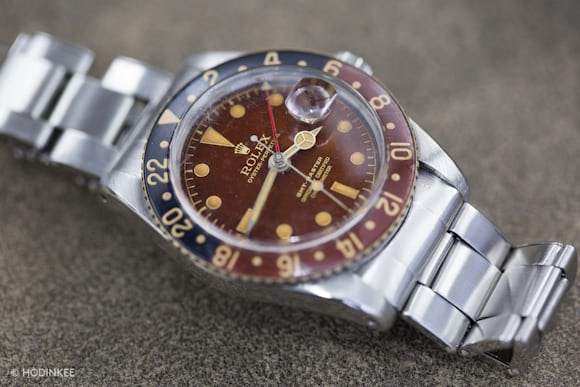
The irony of praising intrinsic defects does not elude me, but frankly this frailty is also what makes this watch so attractive. It was as close to perfection as it was possible to achieve 60 years ago. And all of its little imperfections just got better with time, making this Rolex unique in appearance, and with a real soul. This one was not a safe queen, and it was for the best; it lived like a true tool watch but still looks amazing.

Oh, and this is one lot where you might benefit from the dreaded (or welcomed), "crappy photo effect." The lot image in the catalog does not do this watch justice, at all.

For more on this GMT-Master, click here.

Ben's Pick: 1940s Audemars Piguet Triple Calendar Chronograph
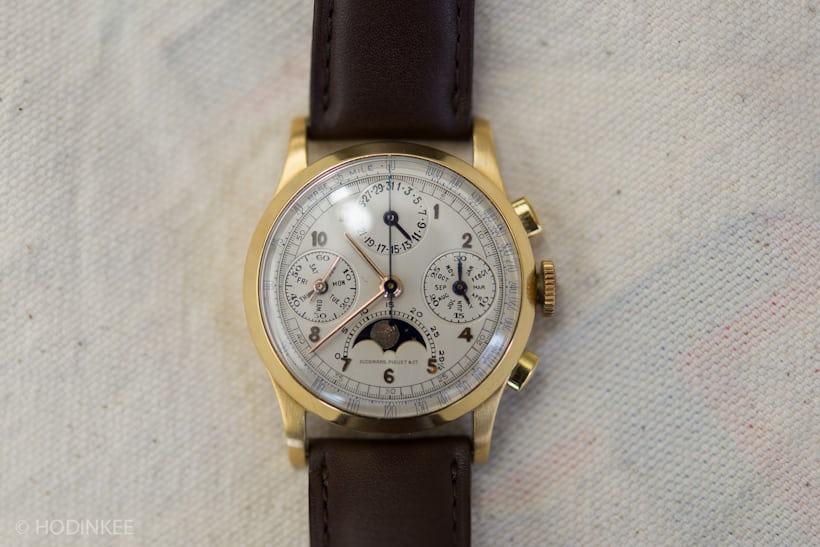
Christie's Geneva 1940s Audemars Piguet Triple Calendar Chronograph

Okay, this sale has some real gems – not the least of which were chosen by my esteemed colleagues here. But there are so many killers in this sale it was really difficult to choose just one for me. Now, the obviously choice here is the steel 530 (hands-on pics coming later today) but that watch will fly no matter what. Some other almost picks for me included the killer 6200 Sub (when was the last time you saw an original one at auction?), the second series 2499 (best watch ever? prob), the steel 140 with box and papers. And frankly, Arthur's Breguet. All amazing watches. But I'm nothing if not consistent, and I still really believe in the value and cool factor of vintage Audemars Piguet complications.

This particular watch is a triple calendar chronograph dating to 1942, and again, what makes these AP's so incredible is just how rare they are. Ten of these watches were made. Ten. That's it. That is one of 36 years worth of production of the 2499, by comparison. And this watch, while a little on the small side, is crisp, honest, and sharp.
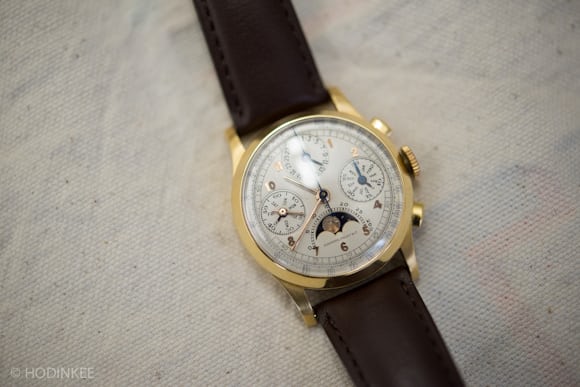
The interest in vintage AP has been rising over the past few years as they've committed to exploring their early wristwatches in greater depth, and I don't see things slowing down any time soon. The estimate for this one is 150,000 to 250,000 CHF, and okay, it's not a perpetual like a 1518, but this watch is just so much more special.

Check out this stunning vintage AP triple calendar chronograph here.

Cara's Pick: Patek Philippe 3448 White Gold Perpetual Calendar
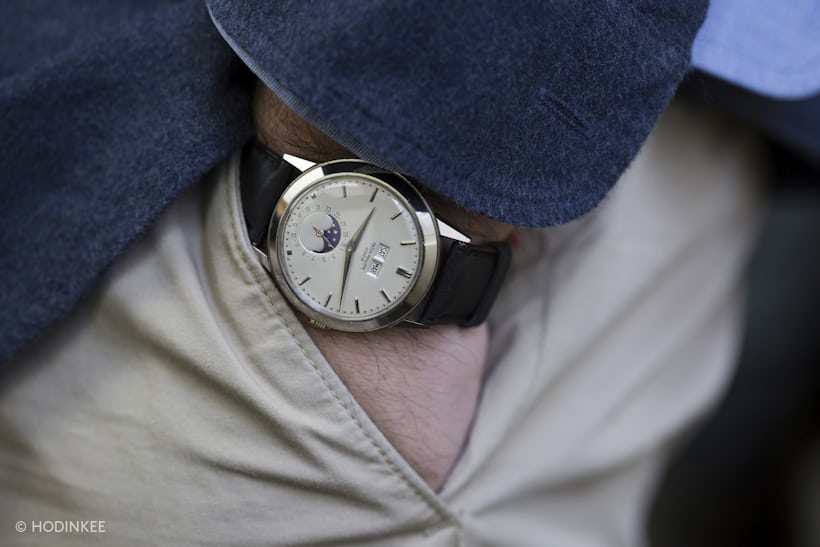
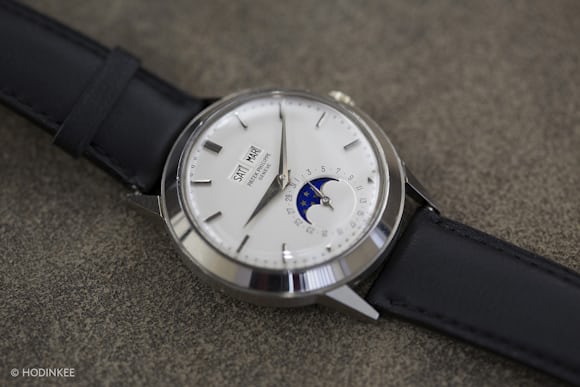
For my auction pick from Christie’s Geneva, I chose my grail watch, the Patek Philippe 3448 in white gold. There is something so pleasantly austere about this watch and I will never forget the first time I saw one (October 15, 2012). It was love at first sight. The sharpness of the lugs, the simplicity of the well balanced dial, the moon-phase (love a moon-phase), and the perpetual calendar function run by the renowned automatic caliber 27-460Q movement. As it should be, the example at Christie’s is in original, unpolished condition (yay!). For me, this is the perfect watch.
Christie's Geneva Patek Philippe 3448 White Gold Perpetual Calendar

Now, you are probably thinking, “yeah, yeah, whatever, we’ve seen this watch before,” but you haven’t. In fact, this particular example has never been at auction, as it was consigned by by the family of the original owner. Oh, and did I mention the rare dial configuration that has never been seen at auction? There were four versions of dials used on the 3448: one with applied enamel baton minute markers; a second with applied dot minute markers and a smaller date ring; a third with applied dot minute markers and large date ring; and a fourth with printed baton minute markers.

The 3448 you see here, produced in 1973, features applied dot minute indexes with a small date ring, but the numbers for the date at the bottom are upside down. This style has only been seen with a large date circle with only five examples known. Additionally, this dial is one of the early “Aprior” dials, which means that the dial is applied with white-gold indexes. (APRIOR stood for Association pour la Promotion Industrielle de l'Or, a gold industry trade association.) This watch, as simple as it it is, shows that it really is all in the details.

Oh and the estimate? A cool 300,000 to 500,000 CHF. Yeah, like I said – grail watch.

More information here.

Wednesday, May 4, 2016

Breaking News: Christie's To Offer Mega Rare Steel Lange 1 With Black Dial In June (Live Pics, Estimates)

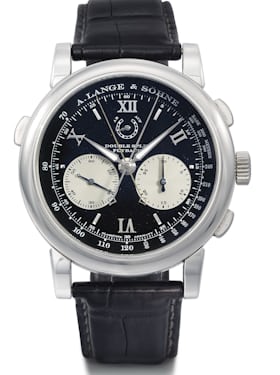
A. Lange & Söhne's short 21-year history has been one of immense success – offering truly cutting edge horological developments and design classics by the caseload. In fact, I would venture to say nobody, in Germany or Switzerland, has done as much for watchmaking over the last two decades as Lange. Still, auction results have been tepid. This will change, I'm sure of that. And what will help change things at a macro level are micro-level moments of success, likely driven by early production rarities. Take, for example, when the only known Double-Split in stainless steel came up at Christie's. It sold for $501,000! Okay, that was a unique piece, but other early watches like the Pour le Mérite tourbillon are also performing well at auction and in the second hand market.

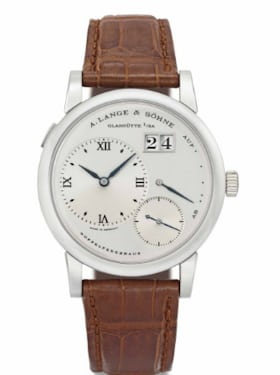
The last steel Lange 1 to sell at Christie's in 2013 brought $154,000. The only known Double-Split in steel brought $501,000 in 2013.

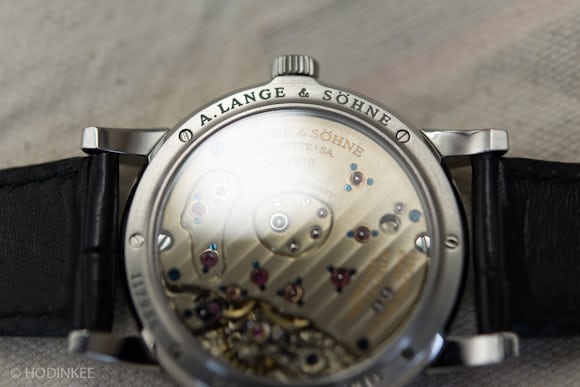
But both the Double-Split and Pour le Mérite tourbillon are serious complications, so on some level, a big price is warranted. The watch that is perhaps the best bellwether of collectible Langes is the Lange 1, the iconic 38.5 mm, time-plus-outsized-date-with-power-reserve model that remains the backbone of the entire collection. Steel Lange 1's were produced in extremely limited quantities during the early days of the company – pre-Richemont – with most being produced in 1996 and '97, and sold in Italy at Pisa. Some claim just 20 pieces were made, though by my math, less than half of that number has actually surfaced. The last one to sell at Christie's brought down $154,000, with a silvered dial and blue hands seen here.

Steel Lange 1 Black Dial

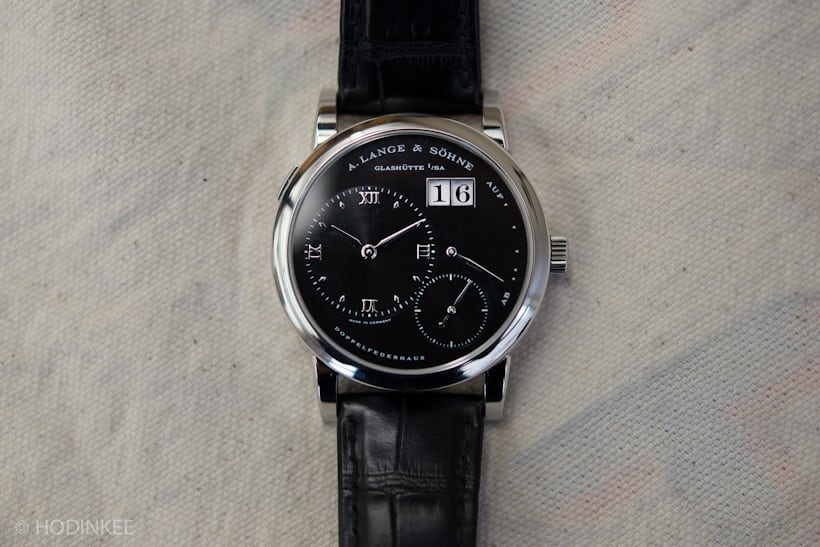
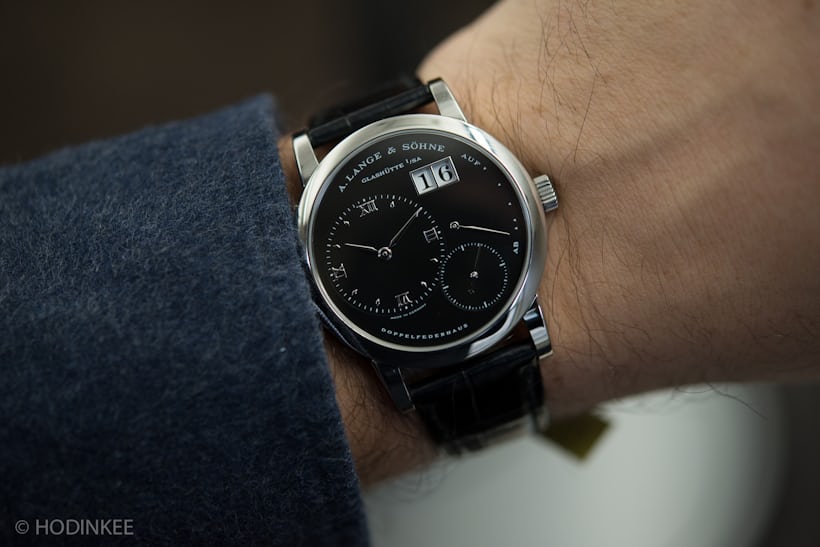
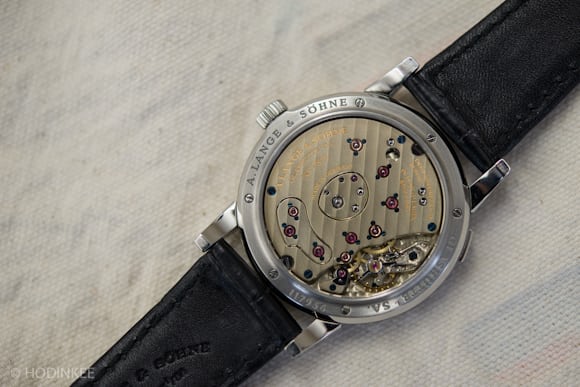
Now if you ask your average Lange connoisseur what a Steel L1 looks like, he'll say, "silver dial, painted numerals, blued hands." And he'd be right, because that's how the majority of the steel watches we've seen have been made. But there exists another dial available on the steel Lange 1 – that of just a basic, black watch. You see one above. Oh, and for the first time, one will be available at a public auction!

Yes, that's right. You will have a crack at taking home one of the absolute rarest Langes in the world – a steel Lange 1, with black dial. The general consenus is that three black dial Lange 1's exist in the world, though as far as I know, that is conjecture. Lange does not confirm such things.

Steel Lange 1

Needless to say, this Lange 1 is one of the coolest modern watches in the world, and one of the rarest. It is a little known configuration of a modern icon, and following the trend of steel Patek time only's bringing six figures, this watch is surely something that will get a lot of people going.

How much, exactly? Well, Christie's has put a mega-estimate on this mega-rare watch: $200,000 to $400,000. Just to be clear, even though silver dial L1's have hit 150k and above, we seldom see estimates of six figures to begin. Here see clear confidence that this very special watch will bring a special result. This Steel Lange 1 with black dial will be offered by Christie's in New York on June 7th.

Oh, and if you were wondering, yes, this is the very same black Lange 1 photographed by Gary over at Quill & Pad. Check this link out for some beautiful high-res imagery.