Thursday, April 28, 2016

Big Ben To Go Silent During Major Renovation Works

A few months back, I contacted my local Member of Parliament (MP) in order to schedule a visit of the Elizabeth Tower. Now, if that strikes you as an odd and roundabout way of getting inside one of London’s most iconic landmarks, rest assured, I was just as surprised to learn that it is, in fact, the only way. Access is also reserved for UK residents, and you can expect to wait at least three months before for an available time slot. Unfortunately, I was told I would have to wait much, much longer than that. I finally know why.

Big Ben Restoration Plans In 2017

On Tuesday, the British government unveiled a three-year restoration plan targeting significant elements of the Elizabeth Tower, including the hands, mechanism, and pendulum of the Great Clock, for which the movement must be stopped. Meaning that, for the first time since 1985, Big Ben will fall silent for several months, starting sometime in early 2017. Meanwhile, tours will be suspended, with the last tour taking place on December 16, 2016.

Steve Jaggs, who is The Keeper Of The Clock – yes, that’s a real title, and yes, I’m jealous of it – said in a statement, “In order to keep the clock ticking, we must now take the time to thoroughly inspect and restore it,” adding the program would “balance value for money with Parliament’s custodial responsibility to the building.”

The Elizabeth Tower itself suffers from leaks, erosion, and severe rusting, issues that can no longer be ignored and require major repairs. An elevator will also be installed inside the tower, and in a bid to reduce the tower’s environmental impact, the British government added it would be replacing the lights that illuminate the clock dials and belfry with low-energy LEDs.

The total project will cost an estimated £29m (or about $42 million).

The Elizabeth Tower was completed in 1859 by British architects Charles Barry and Augustus Pugin, while Sir George Airy, Edmund Beckett Denison, and Edward John Dent worked together on the movement of the clock, which uses a double three-legged gravity escapement (a very sophisticated type of constant force escapement) and the Great Bell. Famously, the rate of the pendulum is still set using pennies, which are added or removed in order to minutely alter the effective length of the pendulum; the addition of one penny causes the clock to run 2/5 of a second faster. According to Parliament records, the total cost of making the clock and bells (the first one cracked before the tower was completed, the second cracked one month after it was installed inside) reached £22,000 in 1863 – which, considering how much tourist revenue the clock has probably attracted in a century and a half, was a good investment.

The last time Big Ben received such attention was in 2007. During the maintenance work, which lasted six weeks, the clock was driven by an electric motor while its bearings were replaced.

Parliament's full statement can be found on its website here.

A Week On The Wrist: The Blancpain Fifty Fathoms Bathyscaphe In Sedna Gold

The Fifty Fathoms watch has been around since 1963, and for its 60th anniversary in 2013, a thoroughly updated version was created: the Bathyscaphe, which takes its name from the undersea exploration vehicle invented by Jacques Piccard. The Bathyscaphe's styling is significantly different from earlier Fifty Fathoms models, and the movement is the very modern caliber 1315, a fast-beat, long-power-reserve engine specifically introduced by Blancpain in 2008 to provide the brand with a performance oriented in-house sports watch caliber. In 2015, Blancpain released a new, Sedna Gold version of the Bathyscaphe – and we just spent a Week On The Wrist with the most contemporary and one of the most quietly luxurious Fifty Fathoms models ever made.

Blancpain Fifty Fathoms Sedna Gold

I really wasn't sure how to feel about the Bathyscaphe at first. In the context of the Fifty Fathoms line, it's a big departure both in size and in style from the historical Fifty Fathoms timepieces. There are four basic models in current production – the Bathyscaphe; what I suppose you could call the "original" Fifty Fathoms; the highly technical X-Fathoms; and the 500 Fathoms GT, which is water resistant to 1,000 meters and is being produced in a limited series of 500 watches. The original style Fifty Fathoms is now a 45 mm watch – I miss very much having a smaller version of the FF in steel available; the Anniversary model, with a sapphire bezel and a 40 mm case, was extraordinarily beautiful and very wearable and I have been wishing, with an increasing sense of futility, for it to return as a regular production model for many years.

The Bathyscaphe, on the other hand, is a 43 mm watch, takes a 23 mm strap, and is 13 mm thick. By the numbers, it's right at the edge of what I'd consider a wristwatch you can wear on a day-to-day basis, so I was pleasantly surprised to find that, the use of Sedna gold for the case notwithstanding, it didn't feel excessively large; it was actually immediately comfortable. This was partly thanks to the excellent nylon strap and beautifully made folding buckle; the latter is also in Sedna gold, and what in steel is a great piece of machinery becomes, in gold, almost opulent.    

Blancpain Fifty Fathoms Sedna Gold strap Blancpain Fifty Fathoms Sedna Gold buckle

Sedna gold is interesting stuff to look at every day. There have been some interesting experiments with gold alloys going on from different brands in recent years; sintered gold/ceramics from Hublot, Lange's Honey Gold, and so on. Sedna gold was introduced for the first time in the Swatch Group by Omega, for the Constellation Sedna, in 2013, and it's a combination of gold, copper, and palladium. Palladium is a platinum group metal and it does the same thing in Sedna gold that platinum does in Rolex's Everose: prevents the characteristic tarnishing that can occur due to the presence of copper. Technically speaking, Sedna gold is an 18k rose gold and a very sensible choice for a dive watch, especially as contact with water can hasten the discoloration. Sedna, as readers who are astronomy buffs might know, is the name of a very distant minor or dwarf planet (about 31 times farther out than Neptune), but it's also the name, in Inuit mythology, for a goddess of the sea, which is pretty appropriate for a dive watch.

I'm curious about the percentage of palladium and copper, because although the redness of copper is definitely there, Sedna gold seems a bit paler to me than conventional rose or red-gold alloys and depending on how the light's reflected, it can range in color from a pale pink to almost white. It's a beautiful effect, and it keeps the watch from seeming too overtly ostentatious; technical watches in precious metals can seem overdressed if you're not careful, and the coloration of Sedna gold allows the Bathyscaphe to keep its technical character.

Blancpain Fifty Fathoms Sedna Gold case flank

The bezel has a ceramic insert – again, from a practicality standpoint this is an excellent choice, especially for salt water immersion. As you'd expect from what, its surprisingly discreet demeanor notwithstanding, is definitely a luxury dive watch, operating the bezel is both smooth and precise; there's just enough resistance to give you tactile feedback as to bezel position, and marker positioning is spot on. Blancpain really nailed the haptics of bezel operation very well in the Bathyscaphe.

One of the things I've always wondered about with the Bathyscaphe is what impression you'd have of the dial proportions over time. Ever since the first time I'd seen it, I thought the dial seemed a little empty – as if too few elements were being dispersed over too large a space. This is really an aesthetic issue, not a practical one – the Bathyscaphe is legibility personified, as a matter of fact. The bezel also seemed a bit narrow at first sight as well. However, over the week I wore it, it started to seem more an advantage than not – the effect is actually rather restful and, in any case, Blancpain has a long history of effective use of negative space and I came to feel that the sparseness of the dial was a big part of what gave the watch its character.

Blancpain Fifty Fathoms Sedna Gold movement

The movement, as we've already mentioned, is the caliber 1315 and fittingly, for what is after all a technical watch, it's dressed for work, not the opera. That said, it's a well-finished piece of machinery. It also, by the way, turned in an excellent performance over the week I wore the watch. There was absolutely no detectable daily variation in rate whatsoever – I mean, none. I am reasonably sure that it gained about a half second after a week, but to be honest, to really evaluate the performance of this particular sample I'd have needed to put the watch on a timing machine. If Blancpain's caliber 1315 is controlled at the factory so that this performance is consistent across its production, that's a pretty laudable accomplishment (certainly, it makes the absence of COSC certification a non-issue).

Blancpain Fifty Fathoms Sedna Gold wrist shot

Overall, the Bathyscaphe Sedna Gold was a very pleasant surprise on a number of levels – aesthetics and wearability for one, and pretty phenomenal (if anecdotal) performance chronometrically as well; whoever gets one is going to have a very intelligently design wristwatch that will both serve its technical purpose well and look very unostentatiously handsome doing it. This is a watch that flew a bit under my radar when Blancpain introduced it and having it for A Week On The Wrist was a pleasure – and a chance to experience a design and technical success from Blancpain I might have otherwise missed.  

See the entire Fifty Fathoms collection right here.

The Blancpain Fifty Fathoms Bathyscaphe in Sedna Gold: case, 43 mm x 13.4 mm, 30 bar/300 meter water resistant. Movement, Blancpain in-house caliber 1315, 120-hour power reserve, 28,800 vph, running in 35 jewels; antimagnetic with silicon balance spring. Price as shown, $25,200; currently available.

Don't have the HODINKEE App yet? Get years of amazing watch content plus new stories, breaking news, and access to great new features like HODINKEE Live, free on iOS.

Wednesday, April 27, 2016

Watch Shopping Chicago: A Visit To The New Marshall Pierce (VIDEO)

It seems as if the idea of the family-run, multi-brand, authorized watch store is going the way of the dodo, as luxury groups push to control every aspect of distribution (including the margin) via factory-owned boutiques. What we as consumers miss with these hyper-controlled selling environments is the opportunity to see watches from multiple brands next to each other, and to establish a relationship with the people behind the store itself. If independent and family owned is a big deal for a watch brand, shouldn't it be for a retailer?

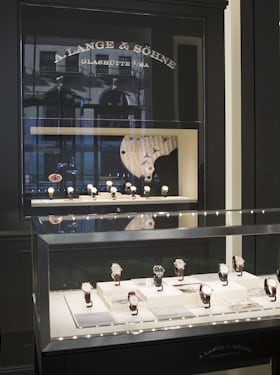
And then you have the new Marshall Pierce & Co. in downtown Chicago. While the name may be familiar to those close to the Chicago watch scene, this third-generation, family-run business revamped itself this past fall with a beautiful new ground floor location on Chicago's Magnificent Mile. What's more, they carry some of the most sought after and interesting watches in the world – think A. Lange & Söhne, Jaeger-LeCoultre, IWC, Cartier, and more. The Bern family, which owns Marshall Pierce & Co., has been in the watch business for an astonishing six generations, and have been owners of Marshall Pierce for three.

Have a look at our visit to Chicago's Marshall Pierce & Co. in our video above, then take a look at some of the watches they have available below.

Cartier

Above we see the Cartier Tank Louis in 18k yellow gold; it measures 33.7 mm by 25.5 mm and features a crown inset with a sapphire cabochon.

Vacheron Constantin

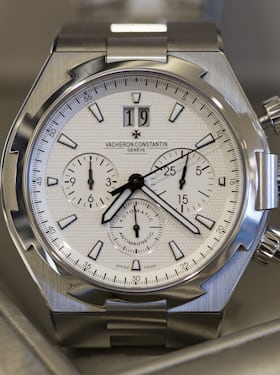
Here, on the wrist of Marshall Pierce Timepiece Specialist Saul Hernandez, is the 42 mm Vacheron Constantin Overseas Chronograph in stainless steel.

Panerai

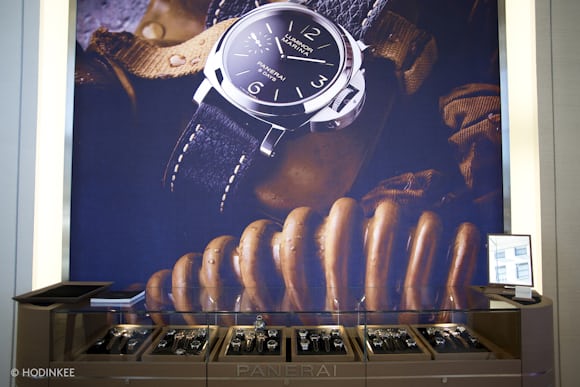
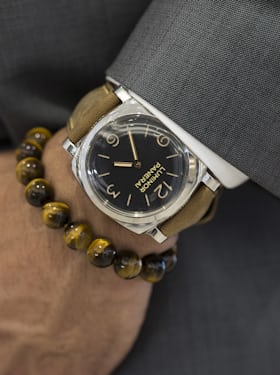
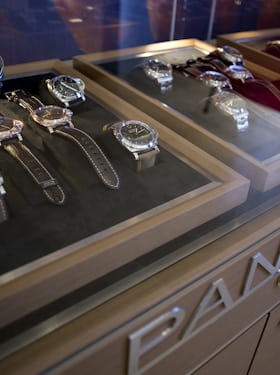
Below left we see the PAM557, the 47 mm Luminor 1950 3 Days.

IWC

Above is the 40.9 mm IWC Portugieser Chronograph 3714 in stainless steel.

Jaeger-LeCoultre

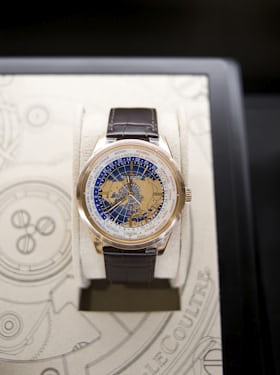
Below left, the 39 mm Jaeger-LeCoultre Master Calendar in stainless steel; below right, the 41.6 mm Jaeger-LeCoultre Geophysic Universal Time in pink gold.

A. Lange & Söhne

Above, on the wrist of Marshall Pierce Timepiece Specialist Derrick Broadway, is the A. Lange & Söhne Grand Lange 1 in white gold; below right, the Richard Lange "Pour Le Mérite" Tourbillon.

Baume & Mercier

Below left, we see the 44 mm Baume & Mercier Capeland flyback chronograph; below right, the Baume & Mercier Classima.

Marshall Pierce & Company is located at:

960 N. Michigan Ave.
Chicago, IL 60611 (click for map)
(312) 642-4299

For more, visit their website, and follow them on Instagram.

Don't have the HODINKEE App yet? Get years of amazing watch content plus new stories, breaking news, and access to great new features like HODINKEE Live, free on iOS.

Watch Industry Veteran William Massena To Lecture At The Horological Society Of New York

Can watches be an effective investment, or is this merely a marketing myth perpetuated by the watchmaking industry? At the May meeting of the Horological Society of New York, William Massena will address this question and more. Massena's illustrated talk will look at notable auction results as case studies, consider how marketing affects the horology industry today, and what challenges this poses to the watchmakers of tomorrow.

William Massena

About William Massena

William Massena (see his Talking Watches episode here) is the managing director of TimeZone.com, the world’s largest online watch discussion forum, to which he has been a key contributor since its founding in 1995. He is also a partner at Digital Luxury Group, a Geneva-based marketing and communication research company for luxury brands. Previously, he was the Chief Operating Officer and Managing Director of Antiquorum S.A., the leading horological auction house.

All HSNY lectures are free and open to the public. Doors open at 6:00 p.m. for coffee and conversation. Lecture begins promptly at 7:00 p.m. For more information, visit HSNY's website.

Monday, May 2, 2016, 6-9 p.m.
HSNY at the General Society Library
20 West 44th Street, between 5th & 6th Avenues
New York, New York, 10036

HODINKEE is a sponsor of the Horological Society of New York

In The Shop: A (Truly) New-Old-Stock Heuer Autavia, An Original Longines Lindbergh, And The Most Amazing Piece Of Vintage Rolex Ephemera You've Ever Seen

Another week at the HODINKEE Shop is upon us, and that means more certified vintage watches available for you, along with some new rare finds. This week we've got some very, very clean chronographs, including a truly brand new, never used Heuer Autavia, a truly special Longines (or two) and a fantastic waterproof Vetta. Oh, and something special for the Rolex ephemera lovers out there. Keep reading if you love the Concorde. (Come on, who doesn't love the Concorde?)

An Original 1940s Longines Lindbergh Hour Angle

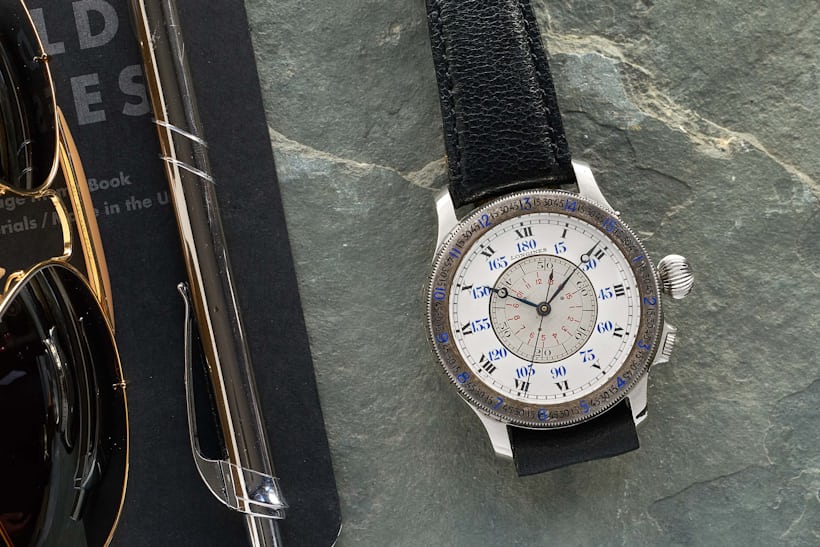
The Longines Lindbergh is one of the most fascinating watches of the 20th century – developed with legendary aviator Charles Lindbergh himself. Don't believe us, read Jack's exhaustive piece ("in-depth" doesn't do it justice) here, where he dissects the science behind the incredible watch. Longines has revived the model in its heritage collection but we've gone ahead and found an original example, dating all the way back to 1942. This is the real deal, people, and you can find it here.

1960s Heuer Carrera Reference 2547S Triple Calendar Chronograph

This ain't your average '60s Carrera, people. In fact, most people wouldn't even know it is a Carrera because unlike the more common example, it doesn't say so on the dial. But the 2547 is every bit a Carrera, and adds a dose of complications with a triple calendar on top of the chronograph. Though this piece dates to the late 1960s, it feels quite a bit earlier, as this combination of complications were popularized in the 1940s and '50s. This is a very special Heuer, for someone looking for something that punches way above its weight class. Find it here.

1960s Enicar Aqua Graph

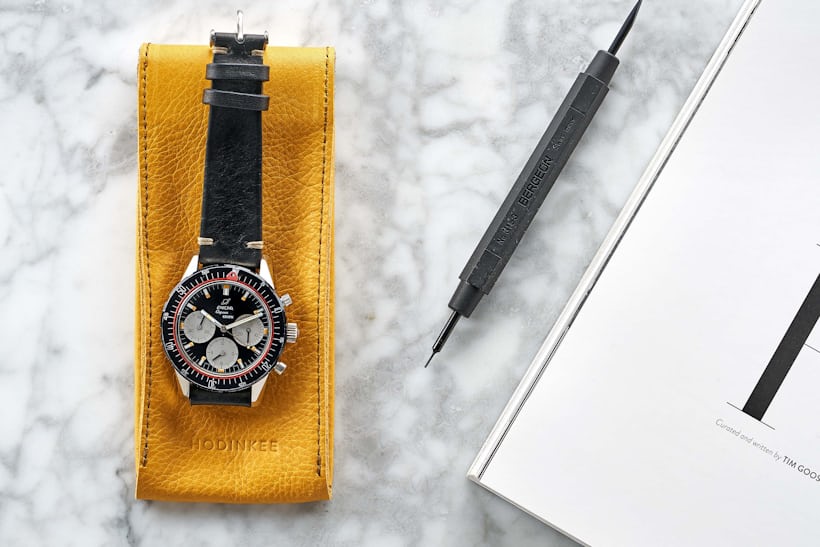
The Aqua Graph from Enicar is what we call a "Cult Classic." This oversized diver's chronograph has languished in the background for years while those from bigger brands jumped to the foreground – now it's Enicar's time to shine. This maker of true tool watches is hot right now, and no model more so than this 40 mm chronograph. Good size, great looks, good history. Find it here.

1970s Heuer Autavia 1163V In Truly Unused Condition

The Viceroy Autavia is one of our favorite 1970s chronographs – read why here. Thing is, because they were less expensive back in the day, not many of them survived in great shape. Enter this Autavia, consigned to us in absolutely immaculate, truly untouched condition with original hang tags and stickers. This one comes with original strap and buckle, too. You've never seen anything like it. Find it here.

New In Rare Finds: An Original Printing Block For The Famous Rolex Concorde Advertisement

We love discovering the undiscovered, and this is something we'd never heard of, which is why we are so thrilled to offer it here. This is an original printing block for the world-famous Rolex Concorde advertisement, and we are confident in saying you will not find another one anywhere. What is a printing block? It's a template used to produce printed materials at scale, and this is the original block for an ad with which we are sure you are familiar. It reads "If you were flying the Concorde tomorrow, you'd wear a Rolex." Yes, every single Rolex Concorde ad came from this block, and now we have it here in the HODINKEE Shop. How? Well, the owner, who is consigning it to us directly, was a Pan Am man, and it was given to him after someone noticed a Rolex on his wrist – a Thunderbird. His hope in consigning it with us is that it will go to a good home after living in his for the last four decades. Find it right here, or forever hold your peace.

Tuesday, April 26, 2016

Editorial: Amid Sharp Sales Drop, TAG Smartwatch An Unexpected Hit; Patek’s Stern Warns Against Erosion Of Watchmaking Values

The Federation Of The Swiss Watch Industry FH, which provides regular information on the state of the Swiss watch industry, has recently released its analysis for March and it's not good news. Major markets across the board are reporting declines, the market for luxury in general is facing challenges, and everyone seems to have different ideas as to what to do about it.

Sales have been in decline since July 2015, according to the FSWI, but the year-over-year decline for March is pretty sobering: 16% overall, with certain key markets showing especially sharp drops. The Federation stated, in its report, that "we must go back to the crisis of 2009 to find rates of variation of this order." The Federation also reported that "The main markets were particularly hard hit. Hong Kong recorded one of its steepest downturns, with -37.7%. The United States followed a similar trajectory in March(-32.9%) throwing the country's poor performance into sharp relief. China was clearly negative (-13.7%) undermining the recovery which had begun to take hold at the end of last year."

There are all sorts of different reasons for a decline in Swiss watch sales, of course – political and economic volatility and unrest worldwide for one; over-production and a resulting glut of unsold stock at retailers for another; over-aggressive pricing (long overdue for a correction) as well. And, of course, there's the as yet unanswered, and very difficult to answer, question: how much has the Swiss watch industry been affected by the Apple Watch in particular, and smartwatches in general?

For some brands, the answer during challenging times is to hold your ground and maintain as much as possible a distinctively Swiss identity, and a strong commitment to the image of stability and luxury so many see as essential to modern fine watchmaking. For others, it's to challenge the status quo in all sorts of ways. The entry level for Swiss watchmaking hasn't exactly gotten cheap, but it has become more approachable, with companies like Montblanc and Frederique Constant making a point of getting attention and headlines by figuring out how to offer classic complications at approachable prices. And, of course, Frederique Constant and TAG Heuer both have connected watch/smartwatch offerings as well. But is the game of combining more affordable pricing with adding smartwatches to a company's product offerings, a clever way of staying current and appealing, or a dangerous devaluation of the very qualities that make fine watchmaking attractive?

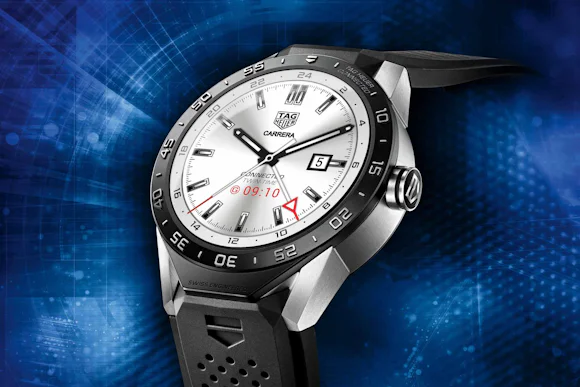
At least one man thinks TAG is going to live to regret its current strategy: Thierry Stern, CEO of Patek Philippe. In an interview with Bloomberg Pursuit's Corinne Gretler, published last March just before Baselworld, Stern was bluntly critical of TAG's approach to its Connected Watch, saying: "It's hard to compete with brands who are very powerful, we're talking about Apple . . . with TAG, again, it's not their field." Stern was also skeptical with regard to the TAG Heuer Carrera Heuer-02T chronograph tourbillon, priced at $15,950, saying (in the same interview) that the watch is "“nearly a joke to me . . .  if they're willing to try to kill the quality of the Swiss product, I think they're on a very good track."

Post-Basel, it's still next to impossible to tell how different survival strategies will pan out over the next 12 to 18 months. The FSWI figures seem to indicate that brands ought to batten down the hatches for more stormy seas ahead, however. One symptom that smartwatches may be eating significantly into export sales is that the biggest decline since last March, by price category, was in the 200-500 franc category (though the difference from the lowest price category – under 200 francs – and the highest – 3,000 francs and over – was not dramatic, at 21.7% vs. 20%).  A surprise for everyone, however, is that the TAG Heuer Connected watch is meeting with surprisingly strong demand. At a meeting with HODINKEE at Baselworld 2016, Mr. Biver frankly expressed to us his surprise that demand was so strong, saying that there was demand for 80,000 TAG Heuer Connected smartwatches for 2016 – representing, at a price of $1,500, $120,000,000 in sales. Not an enormous sum, perhaps, for LVMH overall, but nothing to sneeze at either.

Certainly, one of the more significant trends we have seen in recent months has been a re-positioning of certain models to create more welcoming price points at the entry level; just this week, Vacheron Constantin announced its newest Quai de lÎle watch would be offered in steel at just under $15,000, and Frederique Constant has a new manufacture perpetual calendar for an incredible 8,350 francs. While some – maybe many – in the industry fear that such pricing is letting a genie out of the bottle that will prove impossible to put back, for whatever reasons, the industry as a whole seems to sense that consumers moving forward will be increasingly on the lookout for a substantive value proposition. And it also seems to be increasingly aware that over a decade of significant price increases may have resulted in the unwitting abandonment of a solid base of consumers in home retail territories. Whether it's through more attractive pricing, less alienating messaging, entry into the terra incognito that is smart and connected watches, or some combination of all three, the Swiss watch industry at every level is looking for answers to the identity crisis posed by a challenging business environment, in an increasingly chaotic world.

Don't have the HODINKEE App yet? Get years of amazing watch content plus new stories, breaking news, and access to great new features like HODINKEE Live, free on iOS.

In-Depth: The Incredible Watches (And Cars) Of Briggs Cunningham

One of the countless reasons why any given person may have an interest in timepieces is that these little machines, bound to the wrists of their owners, may in fact be witness to greatness. In the ever-growing list of heroes and their watches, today's subject is not near the top for his contributions to exploration – like, say, a Neil Armstrong might be with his Omega Speedmaster – nor for his importance in the macro-level collecting world, like Paul Newman might be with his Daytona. No, Briggs Cunningham is an American hero of a different sort. His name means little to those outside the highest echelons of motorsport and aquatic racing, or classic timepiece and vehicle collecting. But, to those in the know, Briggs Cunningham and his collection of bespoke wristwatches and sports cars are downright legendary. Today, I'll break them down for you.

Who Is Briggs Cunningham, And Why Do We Care?

Cunningham was born into a great Cincinnati industrial family that had built a fortune in railways, utilities, and real estate – the type of fortune that could only be amassed in the United States in the late 19th century. Cunningham's father, Briggs Sr., would use this fortune to invest in the earliest stages of a small "floating soap" company started by two men who claimed their product would revolutionize the act of bathing – their names were William Procter and James Gamble. So yes, Cunningham was born wealthy, but that doesn't mean he was born lazy.

In fact, I would say that Cunningham dedicated his life to the pursuit of motion – something that neither he, nor his equally privileged bride (she was the daughter of a Standard Oil executive) had any need to be associated with. But they were both avid athletes, and though, by some accounts, the couple, when married, was one of the wealthiest couples in history, they feared not for life or legacy in anything they did, and that is why we are talking about them today.

Cunningham skippered the 1958 America's Cup team, and won. He invented a system of rigging for sailboats, still used today, and still named after him. He built his own yachts and power boats. He was the owner of the first Ferrari in America, and the first Mercedes-Benz 300SL Gullwing, ever. He built his own Le Mans qualifying cars, which I'll run through below. And he happened to have been a very serious watch buyer, commissioning two of the most beautiful and functional watches to come out of the 1950s. Let's get into it.

The Stainless Steel Patek Philippes Of Briggs Cunningham

One could argue that while Cunningham knew exactly what he was doing with sailing and automobiles, his legendary status in horology was purely happenstance. Even today, the name Cunningham means little to watch collectors – unlike the names Graves or Packard, two of his contemporaries. In fact, even die-hard fans of the vintage watch game today may be unfamiliar with the watch legacy of Cunningham, simply because his two most special watches have not appeared publicly in almost a decade. The least valuable, but indeed the wristwatch first worn by Cunningham, we've seen more recently.

Reference 565 Breguet – 100,000 CHF At Phillips Geneva, Ca. 2015
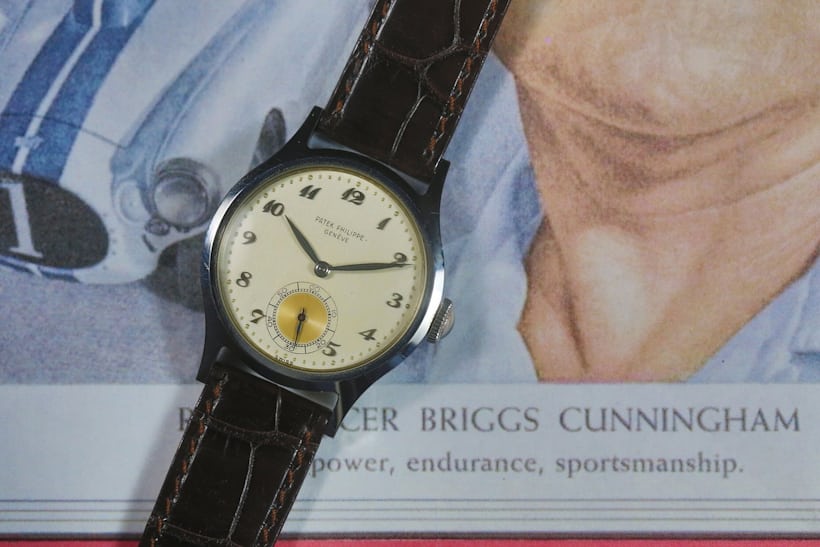
Cunningham is known for owning three Patek Philippe watches – all of them in stainless steel. Two of them are unique commissions designed specifically for the sportsman, while one of them is simply a standard production model. However, this standard production model is a 565 "Calatrava" in stainless steel with Breguet numerals – a watch that to many of us is anything but standard. The watch was built and sold in 1949, before either of his other two watches.

What is so interesting about this piece is that while steel watches were the rage during the war-time years, this watch came later, and is still in mint condition. Further, steel watches were not desired, as they are today, and a man of his means certainly had no reason to choose a steel watch over a gold one – unless, of course, you were Briggs Cunningham and a highly active, top-tier athlete. Then, of course, steel would make sense over gold. This watch has remained in remarkable condition since its birth in 1949, and the watch sold in Phillips' first Geneva auction last may for 100,000 CHF.

While this watch is certainly world-class in terms or rarity, quality, and indeed provenance, its importance also very much lies in the fact that it would set the stage for Cunningham's next two purchases from Patek Philippe.

Reference 1463 Chronograph With Black Luminous Dial – Currently On Offer For $1.5 Million

The next watch in Cunningham's steel Patek collection was certainly a direct commission – a reference 1463 chronograph, made unique by its black dial with luminous markers and hands. The watch, again in stainless steel, has achieved mythical status since first appearing on the market, and remains one of just two black dial 1463s ever to be discovered.
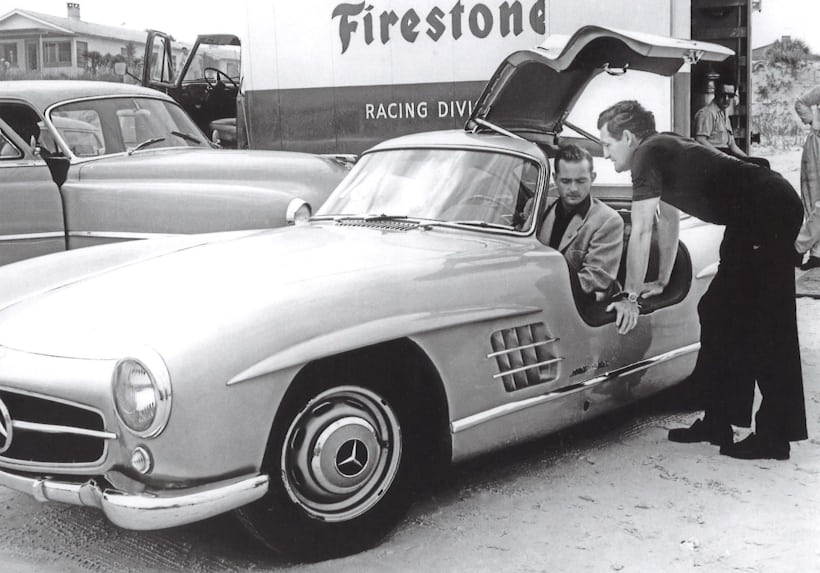
What makes this watch so interesting, besides its obvious rarity, is that it appears to be the watch that Cunningham wore the most. This makes sense; it is highly legible with its radium dial and hands, robust in its steel waterproof case, and functional for his lifestyle, with a chronograph mechanism. If you look at photos of Cunningham through the 1950s, you'll often see a black dial chronograph on his wrist, as you do in the image of him with driver Phil Hill above, ca. 1955. That 300 SL is actually the first Gullwing ever delivered commercially – and the watch, a unique steel black dial 1463. To say Cunningham was doing it right would be a slight understatement, and it's this type of combination that has long made him an icon to me.

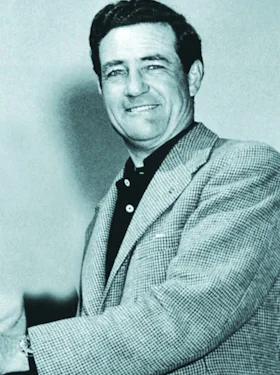
The Cunningham 1463 last time it appeared at auction – 1996. Cunningham again seen wearing his unique steel Patek chronograph.

The last time the Cunningham 1463 sold publicly, it did so via Christie's in June of 1996, in New York. The watch went to a very significant collector, who lent the watch to John Goldberger for publishing in his Stainless Steel Patek book (from which the above illustrations are taken; available here) – you can see it on pages 298-299. Recently, the owner consigned the watch to vintage mega-dealer Davide Parmegiani, who has it on offer for $1.5 million.

Reference 1526 Perpetual Calendar – $3,956,159 At Christie's Geneva, Ca. 2008

It would take a lot to trump a steel 1463 with black military dial, wouldn't it? Cunningham did it, though, with a watch he took delivery of in 1951. This is a reference 1526, otherwise known as Patek's first serially produced perpetual (remember?), but it's steel! And what's more is that this 1526 is different from other 1526's, with a larger, thicker case, and wider lugs. It is just one of just two perpetual calendars to be made in steel, and the Arabic markers are covered in black lacquer. How incredible is that?

This 1526 is certainly one of the most beautiful watches made by Patek Philippe (IMHO) and when it came up for sale via Christie's in 2008, boy did it fly. It sold for 4,137,000 CHF, which was equivalent to a mind-blowing $3,956,159 at the time. The buyer? No one short of Patek Philippe itself – and you can now see this watch on display in the Patek Philippe Museum (at times).

The Many, Many Cars Of Briggs Cunningham

Now consider this, if a man owned the three Patek Philippe watches mentioned above, with little to no actual interest in timepieces or the collecting of them, imagine what he'd do in a category to which he dedicated the best years of his life – automobiles.

1948 Ferrari Tipo 166 Spyder Corsa – The First Ferrari In America

This 1948 Ferrari Tipo 166 Spyder Corsa came into Mr. Cunningham's possession again, not by choice, but by necessity. The millionaire was set on racing at Bridgehampton in 1949, and he intended to do so in a Jaguar XK120. As the race approached, he was told by Jaguar his car would not be ready in time to run and he looked for a replacement – any replacement. Luckily Ferrari importer Luigi Chinetti was there to help and he sold Cunningham this already race-winning Ferrari, what many people believe to be the very first Ferrari imported to the U.S. The car would go on to take the life of one of Cunningham's friends, Sam Collier, who was killed in 1950 at the Watkins Glen Grand Prix, and the car was retired from competition. The car now lives in the Collier collection, and you can see it here.

The 1950 Cadillac Le Monstre – The First American Car At Le Mans

Cunningham had a world-renowned fascination with the 24 hours race at Le Mans, and in 1950, he competed there as the first American entry with American-made car. He did it in the car affectionately known as "Le Monstre" – a wedge-shaped, Cadillac-powered monster of a car. He finished 11th over all, behind his friend Collier, after hitting a sand bank, but the big, loud, brash car was a fan favorite. The car ran at Le Mans classic in 2012, and again sits in the Collier collection.

The Cunningham C-1 And C-2(R)

Cunningham's first foray at Le Mans was moderately successful, but he wanted to push things further. He wanted to build a car from the ground up, under his own name, and race, and win. The C-1 and C-2(R) were Cunningham's first design-to-drive projects and these are true legends of American motorsports. The prototype cars were powered by Cadillac engines, but they were quickly replaced by Chrysler Hemis putting out 180 horsepower. By the time Watkins Glen came around in 1951, the engines had been tweaked up to a whopping 250 hp, in 1951! Five of these cars made the trip to Le Mans, where one clocked in at a record setting 152 mph on the Mulsanne straight, and reached as high as second at one point. Ultimately, Cunningham finished in 15th after a connecting rod failed, but the program was considered a success. Below, I'll tell you about my personal experience with a C-2.

The Cunningham C-3 – The Peak Of Luxury And Performance In 1953

While Cunningham had his sights set on victory at Le Mans, he also dreamt of the day when an American-made consumer sports car would rival Ferrari and Maserati. The C-3 was his idea of such a concept, and though it was based on the chassis of the race cars that were C-1 and C-2, C-3 featured body work by coach builder Vignale, and an interior that "oozed luxury." The only downside was the $15,000 price tag, a truly monstrous cost back then, and part of that was due to the fact that the chassis was shipped from the Palm Beach factory of Cunningham Motors, to Turin for the body work, then back to Palm Beach for final finishing. Only 30 cars were made, and it was this low production volume that caused the IRS to revoke Cunningham's "manufacturer" status, which in turn damaged funding. The cars remain prizes collectibles and are almost never seen for sale.

The Cunningham C-4, C-5, & C-6 – Regular Le Mans Contenders

The C-4, C-5, and C-6 Cunninghams continued Briggs' pursuit of victory at Le Mans for an American manufacturer. In 1953, driving the C-5R, Cunningham was among the pre-race favorites. After all, he had placed fourth in 1952 behind only the 300 SL Mercedes and a lone Nash-Healey. Cunningham had produced a car that he was sure could compete, and he was right. What he could not imagine, however, was how Jaguar's use of disc brakes would impact the race. He, and the rest of the field, could not compete with the C-Types by virtue of stopping power alone, though a C-4R did come in third and prevented a clean sweep by Jaguar.

1954 Mercedes-Benz 300SL – The First Gullwing, Ever

The Mercedes-Benz 300SL as we know it today is an icon of design and engineering – also of collecting. Owning a Gullwing places you into the upper echelons of automotive connoisseurship, but that was not always the case. In fact, when early importer Max Hoffman convinced the Germans to make the car, he had promised that the very first example would go to a celebrity of sorts. That celebrity happened to be a multi-millionaire, America's Cup-winning professional driver by the name of Briggs Cunningham. What makes the fact that chassis number 003 (001 and 002 actually left the factory after 003) went to Cunningham so interesting is that first, he was in the process of building his own street and race cars at the time (see above) and we know that Cunningham was well versed in the power and balance of the W194 Benz (on which the 300SL is built), having lost to them at Le Mans in 1952.

This first 300SL is actually a very different car than most, featuring a truly hand-formed body, many parts made out of magnesium instead of aluminum, a slightly shorter chassis, a shorter vertical shifter, and a fixed (instead of tilting) steering wheel. Some of these traits were requested by Cunningham in pursuit of the best car to drive on the track, while others were simple Mercedes-Benz pre-run production traits.

While the immense importance of the first 300SL is obvious today – hell, it's on the National Historic Vehicle Register – it wasn't so clear back then. Cunningham was more interested in racing his own cars, and the occasional Jag rather than this big Mercedes. One of his team drivers, Phil Hill, did drive the 300SL competitively, but without much success. By 1956, the car had already been sold to a friend of Cunningham's, who did do quite well with it. The car traded hands a few more times before coming to Mr. Dennis Nicotra, who still owns the car today. He did place it up for auction in 2014, but bidding failed to reach the $3.5 million reserve, which, by rough estimates, is about double the value of your average 300SL at auction. Again, while the car did not live with Cunningham for more than two years, it is amazing to see the foresight he had in ordering such an important car – just like the 166 Ferrari.

The 1960 Le Mans Corvettes

Nineteen fifty-five was the last year Cunningham would race Le Mans using one of his own cars. It was also the year that a catastrophic crash – killing 80 people – almost brought an end to all of European racing – though Cunningham claimed they were not related. After spending the second half of the decade racing successfully in the U.S. using Jaguars, OSCAs, and Porsches, a rule change at Le Mans would allow for a larger engine and more "GT" style cars – such as what had since become the great American sports car – the Corvette. In 1960, Cunningham outfitted a team of Corvettes for Le Mans, and was moderately successful, finishing in eighth place overall. The Corvettes in Cunningham's livery have become icons in their own right, and though Chevrolet was not officially involved, they did commission a 34 minute mini-documentary on the run (viewable here). The cars, in recent years, are perhaps most famous for a years-long lawsuit over the ownership of a long-lost example.

Cunningham And His Legacy

Cunningham returned to Le Mans in 1961 driving a Maserati, and he placed fourth. In 1962, he drove a lightweight Jaguar and placed fourth behind three Ferraris (two of them being 250 GTOs). In 1963, Cunningham would make his final attempt at winning Le Mans, again in a Jaguar. He placed ninth, and that would be the end of his long European racing career. Upon completing the 1963 race, Cunningham was granted honorary citizenship of Le Mans for his years of fierce competition and gentlemanly demeanor. He would go on to establish a museum of motorsports in California, before eventually merging it with his friend Sam Collier's collection, now at the Revs Institute. Cunningham died at the age of 96 in 2003.

What I have always found so appealing about the Briggs Cunningham story is two-fold. The first is that he's an American sportsman, who set out to do things his own way. In the world of high end collectible watches and cars, we are so often enthralled by the beauty of great Italian designers and Swiss entrepreneurs – myself no less than anyone – so it's remarkable to see this type of effort put forth by someone from a great American family. What he was able to accomplish during the early years of racing was nothing short of remarkable, and his influence over motorsports in this country is monumental – even if we just look at the first Ferrari and 300SL in the country, two cars that were essentially inconsequential to Cunningham himself. Then you have his contributions with the Cunningham racing team, arguably the most important effort put forth by any American in the 20th century. Without Cunningham, you don't have Shelby, or the GT40. You don't have Corvette at Le Mans.

Finally, in regards to Cunningham's watches – it's clear that he was a man of wealth and taste, but again, the most fascinating thing is that these watches – all steel Pateks, two of them unique and in the seven-figure range – were nothing more than watches to him. So often, when we come into contact with the original owners of what we deem to be mega-watches, they are surprised by how much regard we have for them – as if we're crazy for thinking so much of a watch. And we are, certainly, for Cunningham surely did not purchase any of his Pateks thinking they would be some treasure sitting in a Swiss museum some day; he bought them because they suited his lifestyle, and because he liked them. And that you have to respect.

Driving 1,000 Miles In A Cunningham C-2R

Briggs Cunningham has long been someone I'd wanted to write about, but never did I think I'd have the chance to experience one of his cars in real life. And then, as you know, I attended the amazing Copperstate 1000. One of the participating cars? Yes, a Le Mans-running Cunningham C-2R!
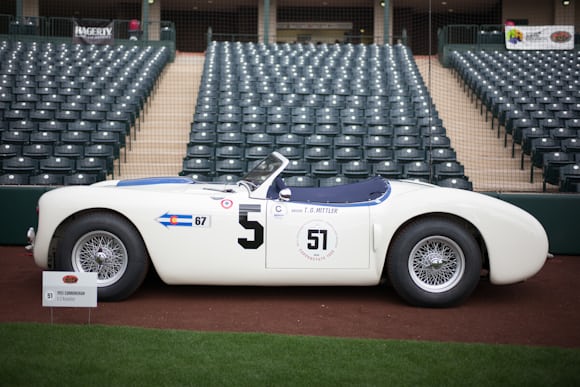
The car ran as high as second place in the 1951 Le Mans, and this particular car even won its class at the Pebble Beach Concourse d'Elegance. What's more, the owner – Mr. T.G. Mittler – could not have been more friendly and sharing of his knowledge of this car. It was purchased by his father in the 1980s, and has been with the family since.

Did I mention the C-2R ran the full 1,000 miles and worked like a charm? That is the most amazing thing about it – this car lives a double-life, winning the world's most important car show one weekend, then slamming through the desert the next.

Here is the 1951 Cunningham C-2R at speed in the desert of Arizona. I have to say, of all the cars in the Copperstate 1000, this was easily the most interesting to me. I'm sure you can understand why.

Did You Know There Was ANOTHER American Car And Watch Builder?

While Cunningham's cars and watches are effectively peerless for the period, he was not alone in his pursuit of motorsport and horological heaven back then in post-War America. Another gentleman, by the name of S.H. Arnolt, who was a distributor for foreign cars in Chicago, also built his own race-spec cars for the American market.

Not only did he build and sell cars, but he also constructed his own oversized chronographs to go with them. Did I mention they were 52 mm in diameter and featured a 14-ligne Valjoux movement? The watches are exceedingly rare, and the last one to come up for sale was in 2011 at Antiquorum, and that one had been converted into a pocket watch!

Obviously, these chronographs were meant to be worn on the outside of the jacket, and I just love the "Warsaw, Indiana" signature on the dial. The cars were discontinued by 1960 after a fatal accident, and Arnolt never had the wide-held acclaim of Cunningham. Still, it's pretty cool to know that there was another crazy American out there in the 1950s making cars and watches.

Credits

This story and the information within would not have been possible without the help of the Briggs Cunningham Foundation, Lawrence Berman of BriggsCunningham.com, the Revs Institute, and most importantly, Mr. John Goldberger.

Don't have the HODINKEE App yet? Get years of amazing watch content plus new stories, breaking news, and access to great new features like HODINKEE Live, free on iOS.